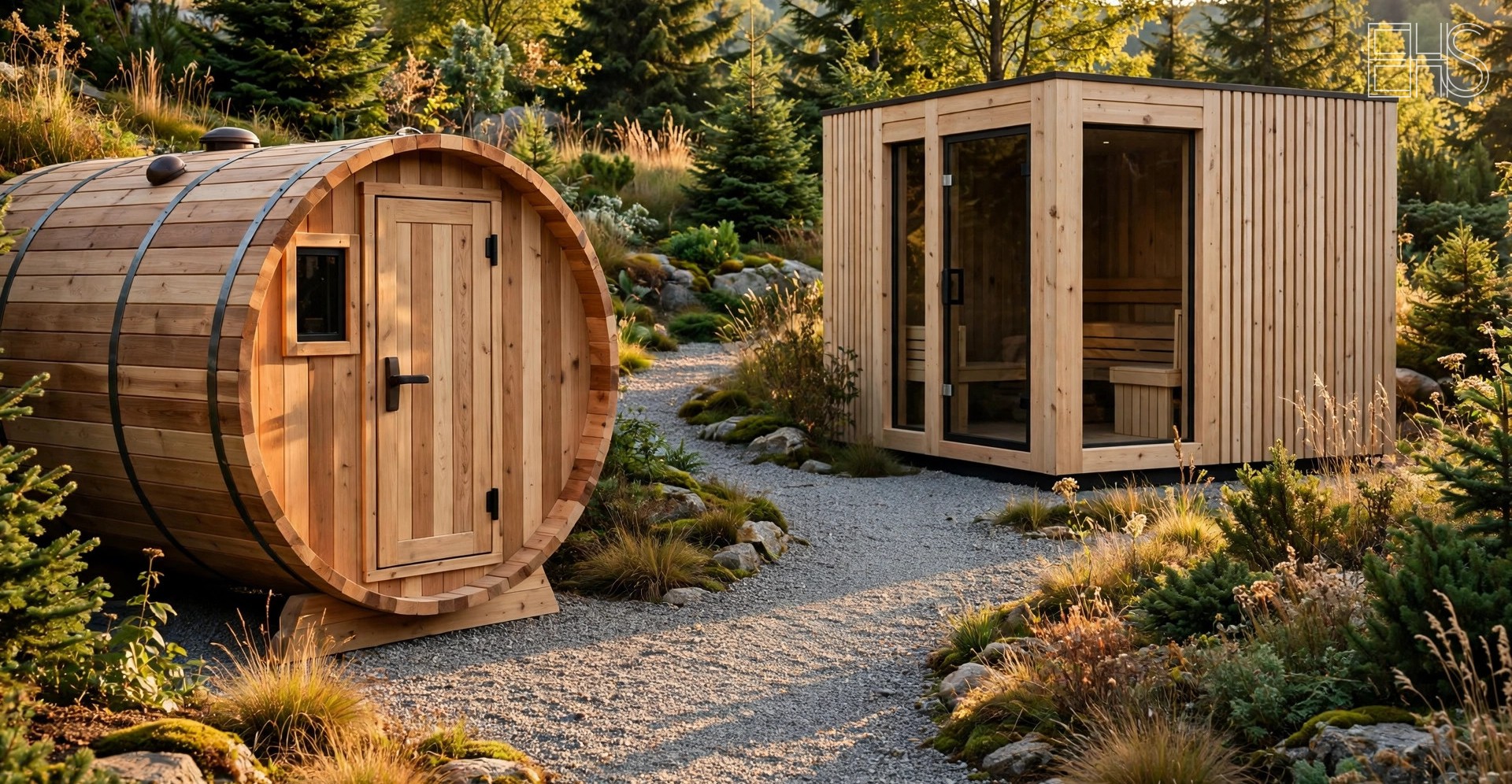
The barrel sauna is the shape everyone recognizes: a wooden cylinder lying on its side, smoke curling from a little chimney, usually photographed beside a lake. The cabin sauna is its rectangular cousin: four walls, a pitched or flat roof, a proper door. Both deliver the same traditional heat. The differences that matter are practical: footprint, heat behavior, build complexity, maintenance, and how each one looks in your garden after five years.
This is not a contest with a winner. Each shape suits a different buyer, and the honest answer depends on your climate, your site, and how you plan to use it.
What Each Shape Actually Is
A barrel sauna is built from horizontal staves bound by metal bands, like an oversized cask. The round profile is structural: the staves press against each other, and the bands hold everything in tension. Most barrels run 6 to 8 feet in diameter and 6 to 12 feet long, seating 2 to 6 people on benches along the sides.
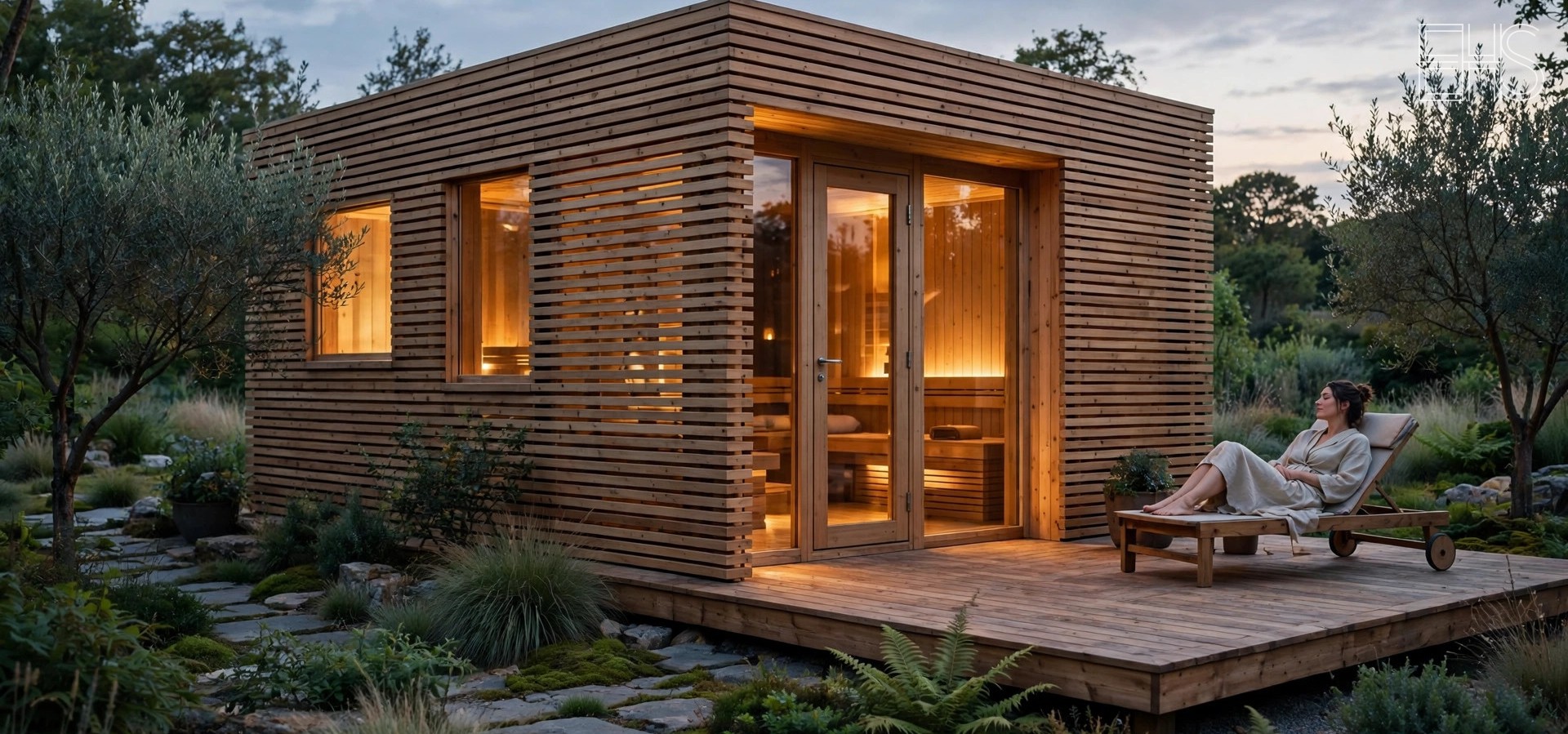
A cabin sauna is conventional post-and-beam or panel construction: vertical or horizontal walls, a framed roof, a door on one end. Sizes range from compact 4-person boxes to large 8-person structures with changing rooms. The shape accepts windows, porches, and second rooms far more naturally than a barrel does.
Heat Behavior: Where the Shapes Differ
This is the most meaningful technical difference between the two.
In a barrel, the round cross-section means less air volume above the bathers' heads and no cold corners. Heat circulates efficiently around the curved interior, and the sauna reaches temperature a little faster for its size. The trade-off is stratification: because the ceiling curves down toward the benches, taller bathers can find the upper bench cramped, and lying down is awkward on a curved bench line.
In a cabin, the rectangular volume holds more air, which means slightly longer heat-up times and a bit more energy per session. But the flat ceiling and straight walls give full headroom and proper lying benches, and the classic two-tier bench layout (upper bench hot, lower bench milder) works exactly as Finnish tradition intends. Temperature control is more precise because the larger air mass buffers the stove's output.
Neither shape is "hotter" in any absolute sense. Both reach the standard 160 to 195°F range with a correctly sized stove. The barrel gets there a touch faster; the cabin holds its temperature more evenly.
The Comparison Table
| Barrel sauna | Cabin sauna | |
|---|---|---|
| Typical price (kit) | $4,000 to $10,000 | $5,000 to $15,000 |
| Heat-up time | Faster (less air volume) | Slightly slower (more air mass) |
| Headroom / lying space | Curved ceiling limits both | Full headroom, proper lying benches |
| Footprint | Compact cylinder, small ground footprint | Larger rectangular footprint |
| Build complexity | Stave-and-band assembly, fiddly solo | Panel or framed assembly, straightforward |
| Maintenance | Bands need periodic tightening; ends weather first | Standard wood-structure maintenance |
| Aesthetics | Iconic, sculptural, rustic | Architectural, blends with house and garden |
| Expansion | Hard to extend or add rooms | Easy to add changing room, porch, windows |
Footprint and Placement
Barrels win on compactness. A 6-foot-diameter barrel occupies a smaller patch of ground than a comparable cabin, and its sculptural profile suits buyers who want the sauna to read as a garden object rather than a small building. The round shape also sheds wind well, which matters on exposed sites.
Cabins need more ground but give more back: the rectangular plan accommodates a changing room, which is genuinely useful in cold climates (somewhere dry to dress, somewhere to hang robes), and a small porch roof over the door, which is the difference between a pleasant entry and a scramble in the rain. If your site has room, the cabin's extra footprint buys real function.
Build and Assembly
Barrel kits have a reputation for tricky assembly, and it is partly earned. The staves must go up in sequence around the cradles, and the final staves need persuasion while the bands go on. It is absolutely a two-person job, and first-timers should budget a full weekend. The reward is a structure with very few fasteners: the geometry does the work.
Cabin kits assemble more like flat-pack furniture: panels or framed walls go up square, the roof follows, and the door hangs on hinges. Most competent DIY pairs finish in a weekend as well, with less swearing. Custom cabin builds by a carpenter or sauna builder are also far more common than custom barrels, which matters if you want something beyond the catalog.
Maintenance Over the Years
Both shapes need the standard outdoor-sauna care: exterior finishing every year or two, ventilation after sessions, stone replacement. Each has its own quirks.
Barrels ask you to check the metal bands periodically. Wood shrinks and swells with the seasons, and bands loosen over time; most manufacturers include a wrench and expect an annual tightening. The flat circular ends also weather faster than the curved sides, since end grain absorbs water: keep them well finished and consider a small roof overhang or full shingle roof on the barrel, which many owners add.
Cabins behave like any small wooden building. The roof is the thing to watch: keep shingles or metal roofing clear and intact, check flashing around the chimney, and make sure the eaves throw water clear of the walls. Otherwise, standard care applies.
Looks: The Subjective Part, Stated Plainly
The barrel is the more romantic object. It photographs beautifully and reads instantly as "sauna" to anyone who sees it. In a rustic or lakeside setting, nothing else looks as right.
The cabin is the more architectural object. It can match the house, take a green roof, carry big glass, and generally behave like a designed outbuilding rather than a standalone sculpture. In a manicured garden or a modern property, the cabin usually sits more comfortably.
Taste is personal, but the property is the tiebreaker: match the sauna's language to the setting's language.
Which Should You Buy?
Choose the barrel if: your site is compact, you love the iconic look, you bathe mostly solo or as a couple, and you are comfortable with the band-tightening ritual. The barrel is the choice of the romantic and the space-constrained.
Choose the cabin if: you want lying benches and full headroom, you need or want a changing room, you entertain groups, or the sauna should harmonize with the house architecturally. The cabin is the choice of the planner and the host.
Both shapes, well built and maintained, will serve for 15 to 25 years. The wrong choice is not a shape; it is a cheap kit in either shape, bought for the price and regretted for the joinery.
A plain-English caution before you buy: sauna heat does not suit everybody. Anyone with a heart condition, anyone pregnant, or anyone uneasy about heat should treat the first sessions gently and cut any session short the moment it feels like too much.
For help deciding between heater technologies before you choose a shape, infrared versus traditional sauna compares the two approaches head to head. For the science-minded, the evidence on sauna benefits separates what is known from what is merely claimed. And if heat versus cold is the open question, cold plunge versus sauna compares the two directly.
Frequently Asked Questions
Are barrel saunas as hot as cabin saunas?
Yes. Both reach the standard traditional range of roughly 160 to 195°F with a correctly sized stove. Barrels heat up slightly faster because of the smaller air volume, while cabins hold temperature more evenly. The bathing temperature you experience depends far more on stove sizing and ventilation than on shape.
Do barrel saunas leak?
A well-built barrel should not leak. The staves swell when humid and seal against each other, and the bands hold the tension. Persistent leaking usually means loose bands (tighten them), dried-out staves on a unit left unused in hot sun (wet the exterior and let the wood swell), or poor manufacturing. A small amount of weeping at the stave joints during the first season is normal and typically resolves.
Which lasts longer, barrel or cabin?
Neither shape has an inherent longevity advantage; lifespan comes down to wood quality, exterior finishing, and maintenance. Well-kept examples of both commonly serve 15 to 25 years. The barrel's specific vulnerability is its bands and end grain; the cabin's is its roof and corners. Maintain those and the shape hardly matters.
Can you lie down in a barrel sauna?
Not comfortably in most models. The curved walls and the bench position relative to the curve make lying awkward, and headroom at the bench ends is limited. If lying down matters to you, which it does to many bathers, the cabin's flat ceiling and straight benches are the better choice. Some large-diameter barrels (7 to 8 feet) improve this, but cabins still win.
Which is cheaper?
Barrel kits typically start lower, often from around $4,000 to $10,000 for the kit, versus $5,000 to $15,000 for comparable cabin kits. But installed cost narrows the gap: cabins more often include changing rooms that add value, and both need the same foundation and electrical or chimney work. Compare all-in project costs, and verify current rates before booking, rather than kit prices alone.
Do barrel saunas need a foundation?
Yes, the same as any outdoor sauna. The barrel sits in support cradles, and those cradles need a level, stable, well-drained base: a concrete pad, compacted gravel with pavers, or a verified deck. Never set the cradles directly on soil. The round shape does not exempt it from the laws of water and frost.