
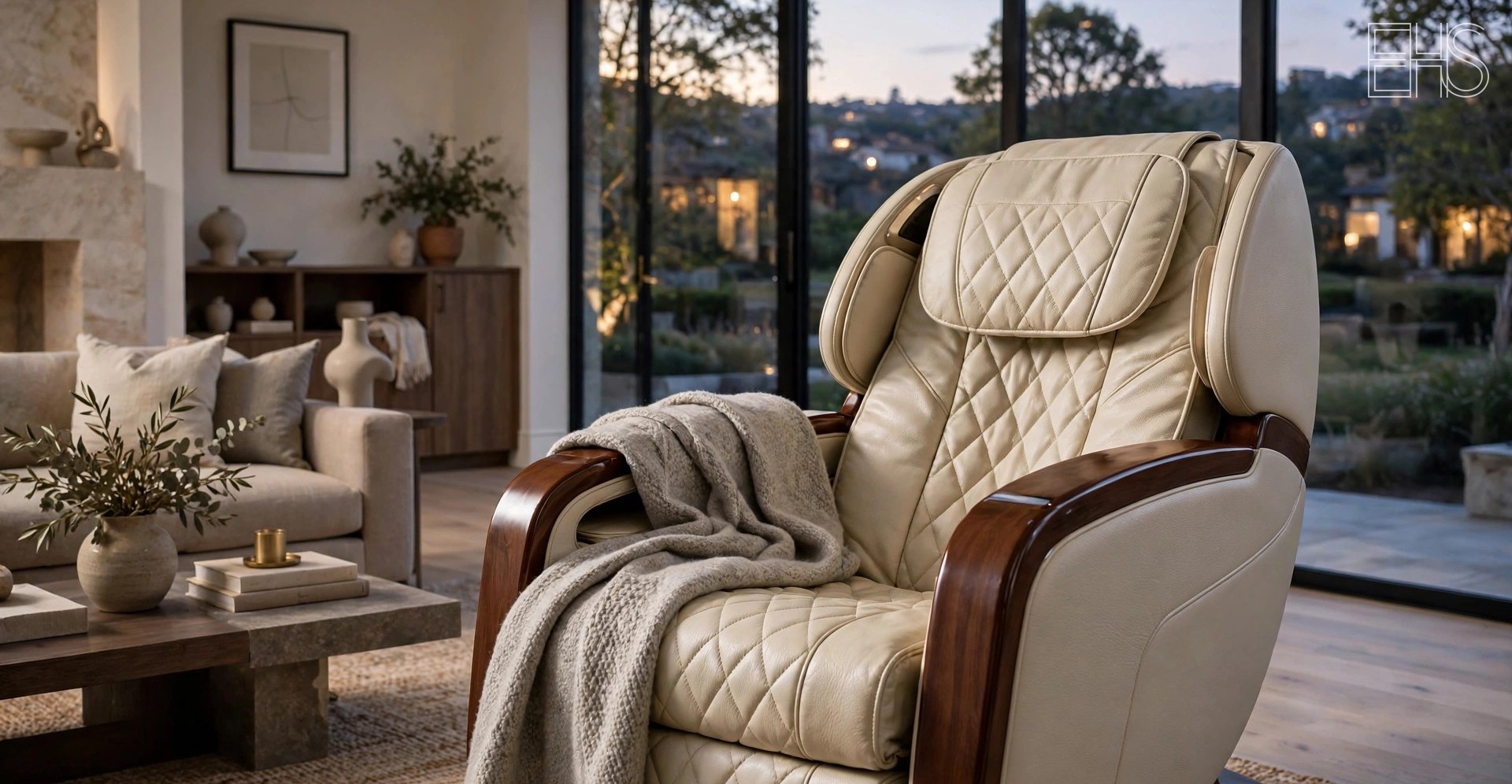
The massage chair is part furniture, part appliance, part statement. At the top tier, prices reach five figures, feature lists read like automotive brochures, and the chairs are substantial pieces of design meant to be seen. Beneath the theater, real mechanical differences determine whether the chair earns its floor space or becomes the most expensive coat rack in the house.
This guide covers what the top tier offers, how mechanisms differ, what to evaluate in person, and the honest limits.
What a Luxury Massage Chair Is
A massage chair is a recliner fitted with mechanical back rollers, limb airbags, and usually heating elements, orchestrated by programmed routines. The luxury tier, roughly $8,000 and up, distinguishes itself through roller sophistication, body-mapping precision, material quality, and overall refinement.
The core of any chair is the roller track. Two designs dominate:
S-track: The track follows the S-curve of the spine, from neck to lower back. Rollers travel this curve, delivering kneading and tapping along the back muscles. The limitation is coverage: the track ends at the lower back, so the glutes and hamstrings get airbags rather than rollers.
L-track (and extended tracks): The track continues past the lower back and under the seat, so rollers travel from the neck all the way beneath the glutes and into the upper hamstrings. Extended coverage is the single biggest mechanical difference between mid-range and luxury chairs, and it is immediately noticeable: the lower-body roller work is what separates a good chair session from a great one.
Beyond the track, the luxury tier adds 3D and 4D roller mechanisms: 3D rollers protrude outward with adjustable intensity, pressing deeper rather than merely traveling; 4D adds variation in the speed and rhythm of that protrusion, meant to mimic human hands. The marketing outruns the mechanics somewhat, but adjustable depth control is what lets a chair suit different bodies.
The Tiers of the Market
Entry chairs ($1,500 to $4,000): S-track mechanisms, basic 2D rollers, airbags for arms and legs, simple programs. Serviceable for casual use, with shallower roller work, cruder mapping, louder operation, and faster-wearing upholstery. Reasonable if you are unsure the category is for you.
Mid-range chairs ($4,000 to $8,000): L-tracks, 3D rollers with real depth adjustment, better body scanning, quieter motors, foot rollers, heating. This is where chairs start to feel like the brochure, and most regular users land here happily.
Luxury chairs ($8,000 to $15,000): Refined 3D/4D mechanisms, precise mapping, extensive zoned airbags, full heating, sophisticated programs, and genuinely good industrial design. Better leathers and synthetics, finer stitching, quieter everything: noticeably more nuanced than mid-range.
Flagship and designer chairs ($15,000 to $30,000+): Including designer collaborations. Mechanical differences over the luxury tier are incremental; you are buying design pedigree, exceptional materials, the quietest operation, and concierge-level service. Furniture first, appliance second.
Prices shift with model cycles and promotions, so verify current rates before booking a purchase or comparing showroom quotes.
What to Evaluate: The Mechanics
1. Track type and length. Confirm track type and how far the L extends, then sit and feel whether rollers reach under your glutes. The most consequential mechanical question is answered by sitting, not reading.
2. Roller depth control (3D/4D). Adjustable depth matters more than the 4D label. Test the full range in the showroom, including the maximum: some chairs' deep is another chair's medium.
3. Body mapping. Better chairs scan your back to locate shoulders and spine curvature, then tailor roller positions. Good mapping puts neck rollers on your neck, not your skull; bad mapping is immediately obvious and one of the clearest tier differentiators.
4. Airbag system. Airbags in shoulders, arms, hips, calves, and feet provide compression. Luxury chairs offer more airbags, independent zone control, and gentler inflation. Foot and calf airbags with integrated rollers are a category highlight; test them specifically, since foot experiences vary most between models.
5. Heat. Lumbar and calf heating is standard in the upper tiers: pleasant, straightforward, and a supporting feature, not a headline. Do not let heat marketing distract from roller quality.
6. Recline: zero gravity and beyond. Zero-gravity recline positions knees slightly above the heart, distributing weight during the session; it genuinely improves the feel of the roller work. Check the reclined footprint: full recline needs significant clearance unless the chair is a wall-hugger design that slides forward.
7. Programs versus manual control. Preset programs are the convenient entry point, but long-term satisfaction comes from manual control of technique, area, depth, and duration. The best chairs offer both. App control is a nice-to-have; a well-designed remote matters more.
8. Noise. The chair gets used while others are home, possibly while someone dozes. Roller and airbag mechanisms vary enormously in noise. Showroom floors are loud; ask for a quiet moment or trust owner reviews. A chair that clunks and whirs is a chair that gets used less.
Materials, Design, and the Furniture Question
At luxury prices, judge the chair as furniture. Upholstery determines feel and longevity: top-grain leathers and high-end synthetics age gracefully; cheap synthetics crack within a few years, and reupholstering is rarely economical. Check stitching, seams, armrests, and headrest.
Design matters because the chair dominates a room; the better brands employ actual industrial designers, visible in proportions and palettes. Measure twice: 5 to 7 feet of reclined length, 3 feet of width, plus clearance. A chair that overwhelms the room breeds resentment regardless of roller quality.
Darker upholstery hides wear; lighter shows it. In a sunlit room, ask about UV resistance.
Realistic Expectations
A good chair delivers a genuinely pleasant mechanical massage on demand; that is the whole honest case. Regular users report loosened muscles, deep relaxation, easier evening unwinding. The convenience is underrated: a massage available in ten minutes at home is a habit; one requiring an appointment is an occasion.
What a chair does not do: replicate a skilled practitioner, adapt to what it finds, or produce the systemic effects sometimes claimed. It works the areas it reaches, in the patterns it knows. Claims about improved circulation or lasting structural change run ahead of evidence.
The honest comparison is chair versus nothing: fifteen minutes most evenings is a meaningful relaxation ritual for those who build it. Buyers expecting the chair to fix a bad back are buying disappointment at luxury prices.
Safety and Who Should Be Careful
Massage chairs are electrical, mechanical devices applying significant force, and they are not for everyone. Keep the force away from recent injuries, surgical sites, and acutely painful or inflamed areas. People with osteoporosis or spinal conditions should seek qualified guidance before using mechanical rollers; pregnancy is a reason to pause and get professional advice. Those with implanted electronic devices should check with the manufacturer and a qualified professional.
For everyone else: start gentle and shallow, increasing gradually. Sharp or radiating pain is a stop signal. Keep to the suggested 15 to 30 minutes; longer is not better. Supervise children around the chair: mechanisms, recline motion, and pinch points are not toys.
Cost Tiers and the Value Question
| Tier | Typical price range | What defines it |
|---|---|---|
| Entry chairs | $1,500 to $4,000 | S-track, basic rollers, casual use |
| Mid-range chairs | $4,000 to $8,000 | L-track, 3D depth, the value sweet spot |
| Luxury chairs | $8,000 to $15,000 | Refined mechanics, mapping, materials, design |
| Flagship and designer | $15,000 to $30,000+ | Design pedigree, finest materials, service |
The value sweet spot is the mid-range to lower-luxury band, where L-tracks, real depth control, and good mapping converge. The jump to flagship buys design and service more than mechanics: worth it for a visible piece in a designed interior, not where the massage transforms.
Critical advice: never buy without sitting in the exact model. Roller feel, mapping accuracy, airbag temperament, and noise are subjective and body-specific; identical spec sheets can feel completely different. Fifteen-minute showroom sessions per finalist are the due diligence this price demands. Confirm white-glove delivery terms, including old-furniture removal and warranty service.
Massage chairs pair with a broader home recovery setup. Our home hyperbaric chambers guide covers another passive recovery option, and our contrast therapy protocols describe heat routines complementing an evening session.
Living With Them: The Practical Side
A luxury chair needs a permanent home: plan footprint, recline clearance, and outlet proximity, then stop moving it. Daily use is typically 15 to 30 minutes, often as an evening wind-down. Upholstery needs occasional cleaning; leather needs conditioning. Rollers, airbags, and electronics wear, so a service plan or clear warranty-service path matters.
Ownership bifurcates: households that build the evening session into their routine use the chair for years; those that bought the idea watch it become furniture in the unflattering sense. Before buying, ask concretely: which fifteen minutes of your day does this replace, and will you protect that time six months from now?
Frequently Asked Questions
Are expensive massage chairs actually better than mid-range ones?
The important mechanical thresholds, L-track coverage, adjustable depth, accurate mapping, are crossed in the upper mid-range. Above that you pay for refinement: quieter operation, finer materials, better design, better service, with diminishing returns past roughly $8,000 to $10,000. Past $15,000 you are largely buying design and brand.
What is the difference between 3D and 4D?
3D means rollers move outward with adjustable depth; 4D adds programmed variation in the speed and rhythm of that depth, meant to feel like human hands. Depth adjustability is the useful part; the 4D label is partly marketing. Judge by sitting and testing the range, not by the number.
How much space does a massage chair need?
Plan for roughly 3 feet of width and 5 to 7 feet of length when fully reclined, plus clearance behind the chair unless it is a wall-hugger model that slides forward as it reclines. Measure your actual room, including doorways for delivery: these chairs are heavy and bulky, and white-glove delivery teams need a clear path.
Can a massage chair replace regular massages?
It replaces the convenience and frequency of massage, not the skill. A chair is available in ten minutes every evening at no marginal cost; a practitioner adapts and works with nuance no mechanism matches. Many owners do both: the chair for the daily ritual, a practitioner for the rest.
How long do massage chairs last?
The structure lasts a decade or more; upholstery, rollers, airbags, and electronics are the wear items. Expect upholstery wear in three to seven years and mechanical service on a similar horizon, which is why warranty length, parts availability, and the service network matter as much as the spec sheet.
What should I test in the showroom?
Sit in each finalist for at least fifteen minutes. Test the full depth range, mapping accuracy on shoulders and neck, the foot and calf program, noise in a quiet moment, and the zero-gravity recline. Bring car-test-drive skepticism: the brochure promises, the chair delivers or not, and your back is the only instrument.
This article shares product research for informational purposes and is not a substitute for medical advice; consult a qualified professional with health questions.