The massage gun went from locker-room novelty to household staple in a few short years. The category spans $60 marketplace gadgets to $600 professional tools, and at a glance they all look alike. Underneath, differences in motor quality, stall force, and noise determine whether the device becomes a daily tool or a drawer occupant.
This guide covers how percussive devices work, the tiers on the market, what specifications actually matter, and where the honest limits of the category lie.
What a Massage Gun Does
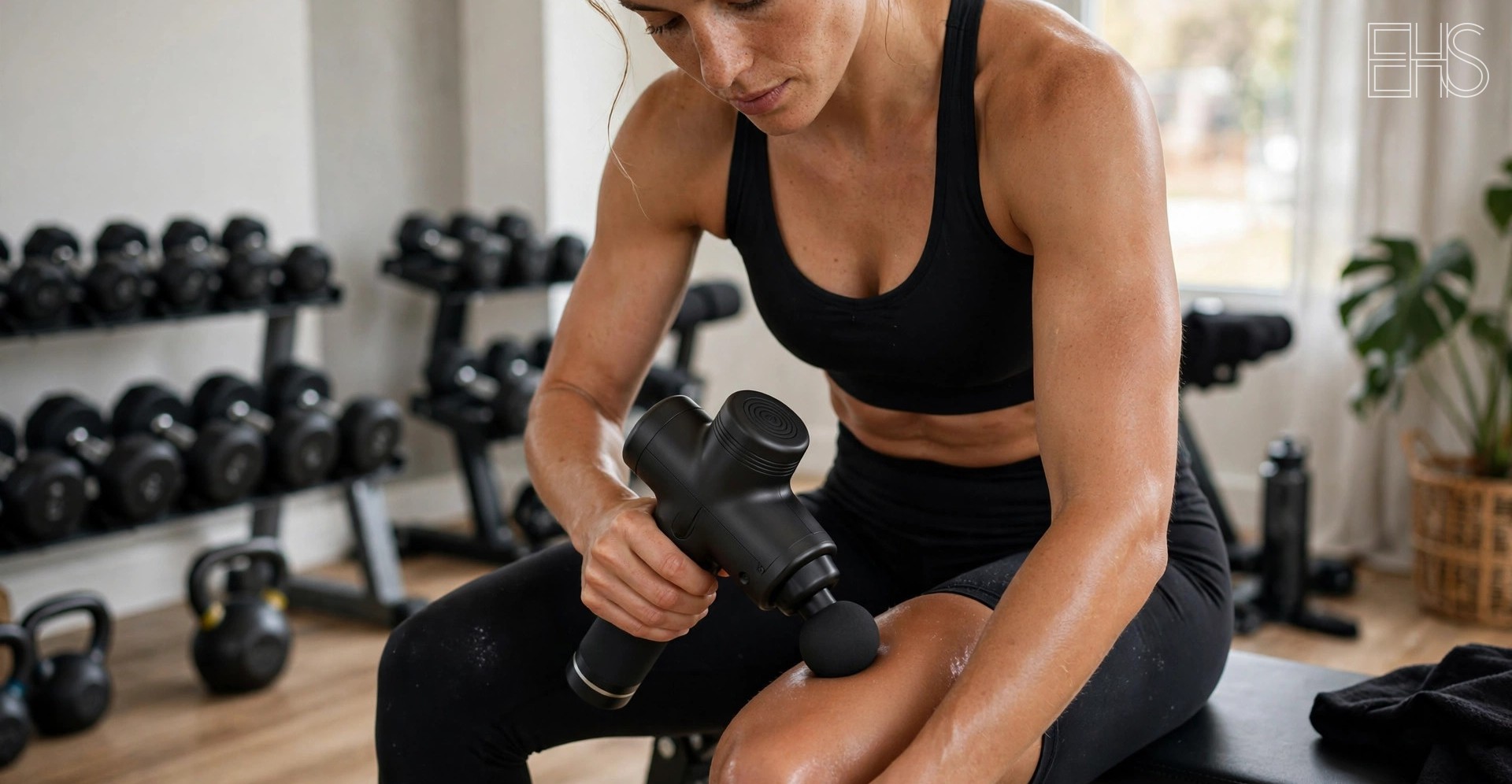
A massage gun, more formally a percussive therapy device, drives an attachment rapidly in and out against muscle tissue, typically at 1,200 to 3,200 percussions per minute. The effect is a deep, rapid tapping that most users describe as satisfying on worked muscles: quads after a run, shoulders after a desk-heavy week, calves after a long day on your feet.
Honestly, it offers convenient, self-administered firm pressure on muscle tissue. It does not knead, adapt, or match trained hands. What it offers is availability: two minutes on a tight calf at 10 p.m. without an appointment.
Manufacturers market effects from faster recovery to increased range of motion; the evidence supports some short-term perceptual effects and little else. Shop with that frame: a pleasant, convenient mechanical tool, not a recovery accelerator with a motor.
The Categories on the Market
Budget guns ($60 to $150): The marketplace tier. Adequate for light use on smaller muscles, but weaker motors stall under pressure, operation is louder, and batteries fade. Fine as an experiment; frustrating as a daily tool for quads and glutes.
Mid-range guns ($150 to $350): The sweet spot for most buyers. Stronger motors with meaningful stall force (the pressure the device sustains before the motor bogs down), quieter operation, several speed settings, a useful set of attachments, and batteries that survive a week of regular sessions. This is where the device starts to feel like a professional tool rather than a gadget.
Premium and pro guns ($350 to $600+): The established professional brands. Refinements rather than revolutions over the mid-range: higher stall force, quieter motors, better ergonomics (rotating arms, better weight balance), pressure sensors with app feedback, longer warranties, and commercial-grade durability. Worth it for practitioners, coaches, and heavy daily users; diminishing returns for the casual user.
Mini guns ($80 to $250): Compact, travel-friendly, lighter and quieter by design, and genuinely useful for travel and smaller muscle groups. The trade-off is power: minis stall sooner and cover large muscles slowly. A good second device; a compromised only device.
Prices move with frequent promotions in this category, so verify current rates before booking a purchase rather than relying on a remembered price.
What to Look For When Shopping
1. Stall force. The single most informative specification. Stall force, measured in pounds, tells you how much pressure you can apply before the motor stalls. Budget guns often stall under 20 lbs; good mid-range guns sustain 40 to 60 lbs. For deep work on big muscles, stall force matters more than any other number, and manufacturers that omit it are usually hiding a weak motor.
2. Amplitude (stroke length). How far the head travels with each percussion, typically 10 to 16mm. Longer amplitude means deeper-feeling percussions. Short-amplitude devices feel buzzy; long-amplitude devices feel thumpy. For larger muscle groups, 12mm and up is the useful range.
3. Noise. The device gets used while watching television, talking, or winding down. Published decibel figures are often measured generously, so treat them as comparative rather than absolute. In practice, brushless motors from the mid-range up are meaningfully quieter than budget brushed motors. Owner reviews mentioning apartments are more informative than spec sheets.
4. Speed range and control. A useful range runs from around 1,200 to 3,000+ percussions per minute, adjustable in sensible increments. Very low speeds are for sensitive areas and warm-ups; high speeds for dense muscle. More speeds are not inherently better; well-spaced, genuinely different speeds are.
5. Attachments. The standard set covers the real use cases: a ball head for large muscle groups, a flat head for dense areas, a bullet or cone for trigger points and small areas, and a fork for either side of the spine and the Achilles area. Beyond the standard set, attachment counts are mostly marketing. Check that heads are firm and attach securely; wobble signals cheap build.
6. Battery life and charging. Sessions are short, so modest batteries last days; still, check real-world figures. USB-C charging is a genuine convenience, and a removable battery is a plus since batteries degrade first.
7. Ergonomics and weight. It is held at arm's length against your own back and shoulders. A pound or two matters enormously over a five-minute session, as does handle shape. Rotating or multi-grip handles genuinely help with hard-to-reach areas. If possible, hold the device before buying.
8. Warranty and support. One year is standard; two years suggests confidence. Motors and batteries are the failure points. At premium prices, expect a reachable support channel and a stated repair or replacement policy.
Realistic Expectations
The evidence for percussive devices is modest and specific. The best-supported finding is short-term: a few minutes of percussive treatment appears to produce a temporary increase in range of motion without the performance decrease associated with static stretching, and users consistently report that treated muscles feel better afterward. That combination, move a bit more freely and feel a bit better, right now, is the honest core of the category.
Beyond that, support thins: effects on soreness are inconsistent across small studies, and effects on measured recovery or subsequent performance are unproven. Claims about breaking up scar tissue or accelerating tissue repair run ahead of evidence; read them as marketing, not findings.
The practical upshot: a good tool for how it feels and for short-term mobility, a weak basis for training decisions. Use it because two minutes on a tight quad feels good, not because it measurably changes recovery physiology.
Safety and Who Should Be Careful
Massage guns are electrical, percussive devices, and they are not for everyone. A few plain rules. Never use one on bony prominences, the front of the neck, the throat area, or directly over the spine; percussive force on bone and delicate structures is asking for trouble. Avoid use over varicose veins, open wounds, rashes, or areas with reduced sensation. Skip the device entirely during pregnancy unless you have qualified guidance, and keep it away from children.
People with blood-clotting conditions, those taking blood thinners, or anyone with a vascular condition should get professional guidance first. Pain is information: a device that hurts is being misused. Aim for firm, comfortable pressure, never punishment, and start at the lowest speed on each new area.
Cost Tiers and the Value Question
| Budget tier | Usual price range | What you get for it |
|---|---|---|
| Budget guns | $60 to $150 | Light use, weaker motors, louder |
| Mini guns | $80 to $250 | Travel-friendly, less power |
| Mid-range guns | $150 to $350 | The sweet spot: stall force, quiet, battery |
| Premium and pro guns | $350 to $600+ | Refinement, ergonomics, durability, warranty |
For most buyers, the mid-range is the rational ceiling. The jump from budget buys the two things that determine daily satisfaction: a motor that does not stall and tolerable noise. The jump to premium buys refinements that matter to heavy users but rarely change five minutes on tired legs.
The value trap in this category is the drawer. Massage guns have one of the highest abandonment rates in home recovery: bought enthusiastically, used for two weeks, forgotten. Before buying, be honest about whether reaching for it will become a habit. If your recovery routine is already consistent, buy with confidence; if you are buying the routine with the tool, start cheaper.
Percussive devices sit naturally alongside other hands-on recovery approaches. Our contrast therapy guide covers heat and cold routines that many people pair with a short gun session, and our red light therapy guide covers a hands-free recovery option for heavy training days.
Living With Them: The Practical Side
Ownership is low-friction, which is the category's real strength. Charge it, keep it where you stretch, use it for two to five minutes per muscle group after training or in the evening. Attachments wipe clean. There are no consumables and no subscriptions worth paying for; app features beyond basic speed control add little.
Two notes from long-term owners. First, less is more: a couple of minutes per area at moderate speed beats ten aggressive minutes. Second, the gun complements movement; five minutes of percussion plus a short walk does more for stiff legs than fifteen minutes of percussion alone.
Frequently Asked Questions
Do massage guns actually speed up recovery?
The honest answer is that they make muscles feel better in the short term and may temporarily improve range of motion, but there is no solid evidence they accelerate the underlying process of recovery or improve performance in your next session. Buy one for how it feels and for convenience, not for a measurable recovery effect.
What is stall force and why does it matter?
Stall force is the pressure the motor sustains before bogging down, in pounds. A gun that stalls when you lean into a quad is useless for deep work on large muscles. Budget guns stall under light pressure; good mid-range guns sustain 40 to 60 lbs. Its absence from a spec sheet is a red flag.
Are expensive massage guns worth it?
Up to the mid-range, yes: the jump from budget buys a motor that does not stall and noise you can tolerate, which are the two things that determine whether you keep using it. Above the mid-range, you are paying for refinements, ergonomics, app features, brand durability, that matter most to professionals and heavy daily users. Most home users hit diminishing returns around $250 to $350.
Can I use a massage gun every day?
For healthy adults, daily use at comfortable settings is generally fine. Keep sessions to a few minutes per area, avoid bony areas, the neck and throat, and anything injured or inflamed. Soreness that worsens with use is a signal to stop and seek professional evaluation if it persists.
Massage gun or foam roller?
Overlapping purposes, different trade-offs. Rollers are cheaper, silent, and excellent for large areas but need floor space. Guns are faster, more targeted, and usable anywhere but cost more. If you must choose one, the roller is the better value and the gun the better convenience.
How loud are they really?
It varies enormously by tier. Budget guns with brushed motors can be genuinely intrusive, loud enough to dominate a room. Mid-range and premium brushless models are conversation-compatible, roughly the level of an electric toothbrush scaled up. Published decibel numbers are measured under generous conditions, so trust owner reviews, especially for early-morning or late-night use.
For general information only: this guide is not medical advice. Anyone with an injury or health concern should check with a qualified professional first.