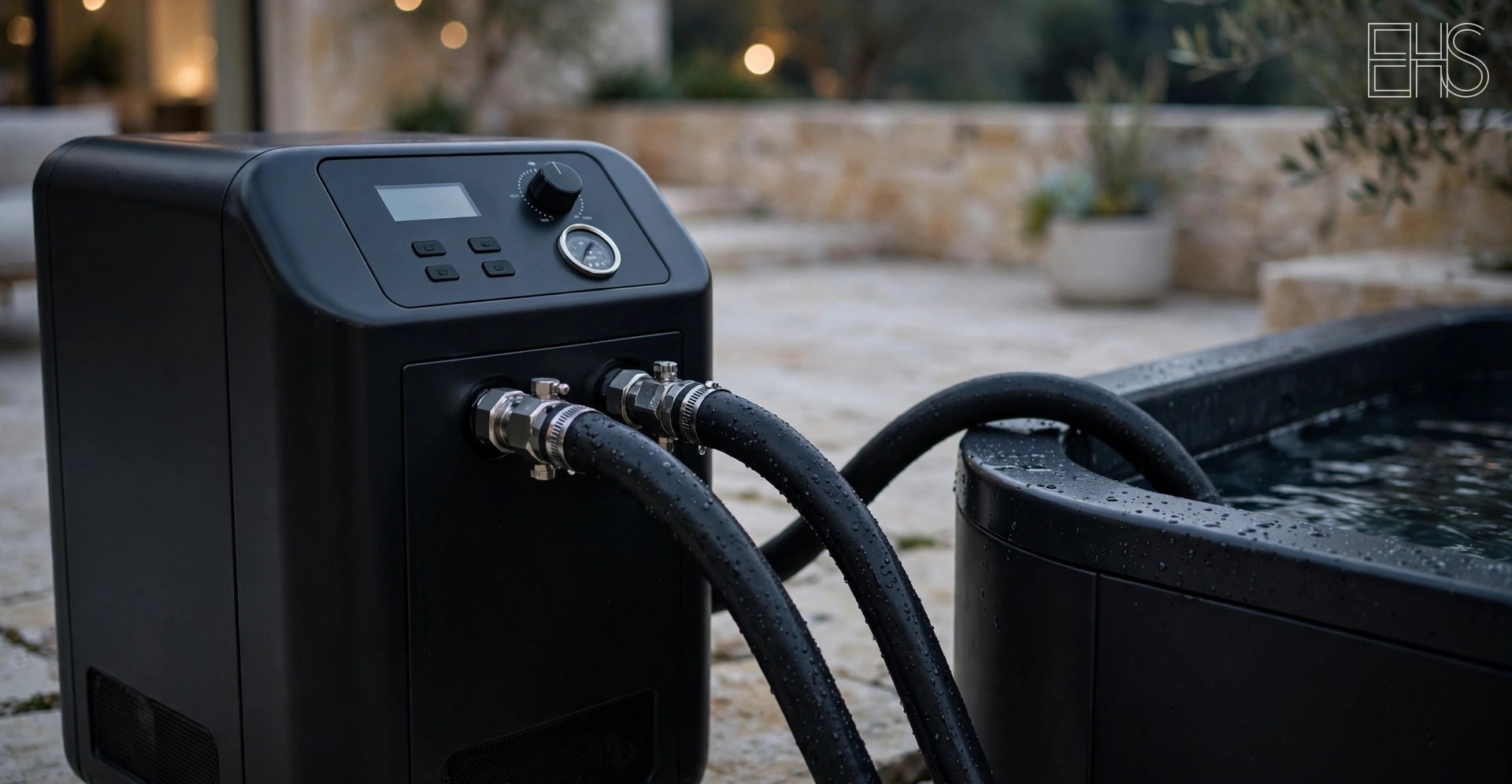
The chiller is the part of a cold plunge system that buyers most often undersize, and the part they most regret undersizing. A chiller that is too small runs constantly, wears out faster, loses ground on hot afternoons, and turns the morning plunge into a question mark. Sizing it correctly is not complicated, but it requires matching three variables honestly: tub volume, target temperature, and climate. This guide walks through the math, the units, and the judgment calls.
One note first: cold immersion is not for everyone. Ease in gradually, keep early sessions short, and skip the plunge on days you feel unwell.
What Chiller Sizing Actually Means
A chiller's job is to remove heat from the water faster than heat enters it. Heat enters from three sources: the ambient air (the biggest one in summer), sunlight on the tub (the second biggest for outdoor units), and you (surprisingly significant: a human body transfers a meaningful amount of heat to cold water over a session).
Sizing means choosing a unit whose cooling capacity exceeds the total heat load with margin to spare. The margin matters because chillers are rated under ideal conditions, and your patio in August is not ideal conditions. An undersized unit does not just cool slowly; it never reaches setpoint, runs at full duty indefinitely, and fails earlier than it should.
Three numbers define the decision:
- Tub volume (gallons or liters): how much water must be cooled.
- Temperature differential: the gap between your ambient conditions and your target water temperature. Bigger gap, bigger chiller.
- Cooling capacity: rated in BTU per hour or horsepower (HP). This is the number you are shopping for.
For the broader economics of chillers versus hauling ice, see our chiller-versus-ice comparison.
Horsepower, BTU, and What the Numbers Mean
Chillers are commonly sold by horsepower: 1/4 HP, 1/3 HP, 1/2 HP, 3/4 HP, 1 HP. Those labels are useful only as broad product classes. Horsepower on the box usually describes the compressor motor rather than a fixed cooling output, and there is no single industry-wide conversion from HP to BTU per hour for plunge chillers, so treat a bigger label as "more cooling" only in a general sense. When comparing models, ignore the horsepower badge and shop the manufacturer's published cooling capacity in BTU per hour, quoted at a stated ambient air temperature and water temperature. Two chillers both labeled 1/2 HP can differ substantially in real output, and the spec sheet's BTU/h figure is the number that tells you which one actually moves more heat.
Here is a practical starting map for a target temperature around 50 to 55°F in a shaded outdoor or indoor location:
| Tub volume | Temperate climate | Hot climate (regular 85°F+ days) |
|---|---|---|
| 60 to 80 gallons (portable / compact) | 1/4 to 1/3 HP | 1/3 to 1/2 HP |
| 80 to 120 gallons (standard tub) | 1/3 to 1/2 HP | 1/2 to 3/4 HP |
| 120 to 180 gallons (large tub / two-person) | 1/2 to 3/4 HP | 3/4 to 1 HP |
| 180+ gallons (extra-large / spa-style) | 3/4 to 1 HP | 1 HP and up |
These are starting points, not specifications. Sun exposure, indoor waste-heat buildup, and aggressive target temperatures (below 45°F) all push you a step up. When in doubt between two sizes, size up: the cost difference between adjacent chiller sizes is typically a few hundred dollars, while the cost of an undersized unit is years of poor performance.
The Three Variables, Honestly Assessed
Tub volume. Check your actual water volume, not the tub's maximum capacity: most tubs are filled to 70 to 85 percent of their listed volume once a person displaces water. A "100-gallon" tub typically holds 70 to 85 gallons in practice. Size to the real number.
Temperature differential. This is where climate does its quiet work. A tub held at 52°F in a 70°F garage faces a 18-degree differential; the same tub on a 95°F patio faces 43 degrees, more than double the heat load. Summer highs, not annual averages, are the number to size for. If your hottest weeks hit 100°F, size for 100°F.
Target temperature. Every degree colder costs disproportionate capacity. Moving from 55°F to 50°F is a modest step; moving from 50°F to 42°F meaningfully increases the load because the differential against ambient grows and the chiller's efficiency falls as water gets colder. If you are unsure of your preferred temperature, start with a standard setpoint and size for it; most owners settle between 50 and 55°F for daily use.
Flow Rate: The Spec Nobody Reads
Cooling capacity gets the attention, but flow rate compatibility decides whether the system actually works. The chiller needs water moving through it at a rate within its specified range: too slow and it cannot transfer heat efficiently; too fast and the water does not stay in the cooling chamber long enough to shed heat.
Match the chiller's recommended flow (usually listed in gallons per hour or liters per hour) to your pump or the chiller's built-in pump. If you are buying a tub and chiller separately, this is the compatibility question to ask: does this chiller's flow range match my tub's pump? Bundles sidestep this entirely, which is one reason our buying guide notes that first-time buyers usually do better with a matched set.
Plumbing diameter matters too. Undersized hoses or excessive fittings create restriction that effectively reduces flow, and long hose runs between a remotely placed chiller and the tub add friction losses. Keep runs short and straight where possible.
Signs Your Chiller Is Undersized
Most owners discover the problem in the first heat wave. Watch for these:
- The water never reaches setpoint on hot days, plateauing several degrees above target.
- The unit runs continuously during summer afternoons with no cycling off.
- Recovery is slow: after a session, the water takes hours to return to temperature instead of under an hour.
- The unit is loud and hot: a chiller working at maximum duty dumps maximum waste heat and noise, which compounds the indoor placement problem.
- Premature failure: compressors that never rest fail earlier. A chiller rated for years of normal cycling can wear out in a fraction of that time under constant full load.
If you already own an undersized unit, partial remedies exist before replacing it: add shade, improve insulation around the tub, keep the cover on religiously, and lower the target temperature less aggressively. These recover some margin, but they do not fix a fundamental mismatch.
Oversizing: Can You Go Too Big?
Mild oversizing is good engineering; gross oversizing wastes money and can introduce its own issues. A chiller dramatically larger than needed short-cycles (turning on and off frequently), which wears the compressor differently but still wears it. It also costs more upfront and draws more power per cycle.
The practical sweet spot is a unit rated for about 20 to 40 percent above your calculated heat load. That covers the hottest week, the occasional second user, and the efficiency losses of real-world plumbing, without entering short-cycle territory. In practice this usually means choosing one size above the minimum the chart suggests for your volume and climate.
Pricing and Running Costs
Chillers typically list from around $800 for entry-level 1/4 HP units to $2,500 and up for 1 HP premium models with advanced filtration, with most well-regarded mid-range units landing between $1,200 and $1,800. Bundles (tub plus matched chiller) often price more favorably than the sum of separate parts. As always with wellness equipment, verify current rates before booking or buying, since pricing shifts with seasons and promotions.
Running costs scale with size and duty cycle: expect roughly $20 to $60 per month in electricity for a typical residential setup, with hot-climate outdoor units at the higher end. A larger chiller that cycles off uses less total energy than a smaller one running nonstop, which is another quiet argument for sizing up.
The Sizing Checklist
- [ ] Actual water volume calculated (filled volume minus displacement)
- [ ] Sized for summer highs, not annual averages
- [ ] Target temperature set; sized for that setpoint, not an aspirational colder one
- [ ] Sun exposure and shade assessed honestly
- [ ] Flow rate matched between chiller and pump
- [ ] One size above minimum selected (20 to 40 percent margin)
- [ ] Power requirements checked against available circuit
- [ ] Placement allows airflow around the chiller (units need breathing room to dump heat)
Get the capacity right and the chiller disappears into the background: silent most of the day, water ready every morning. Get it wrong and it becomes the loudest, hardest-working, shortest-lived part of the system. This is the decision worth an extra afternoon of homework.
Frequently Asked Questions
What size chiller do I need for a 100-gallon cold plunge?
For a true 100 gallons of water at a 50 to 55°F setpoint, a 1/3 HP unit is the minimum in a temperate climate, and a 1/2 HP unit is the safer choice in hot climates or with sun exposure. Remember that a "100-gallon" tub usually holds 70 to 85 gallons in practice once you displace water, which brings the requirement down slightly. When between sizes, choose the larger one.
Is a bigger chiller always better?
Up to a point. A moderately oversized unit (20 to 40 percent above your heat load) runs efficiently, cycles normally, and handles heat waves with ease. A grossly oversized unit short-cycles, costs more upfront, and draws more power per cycle without meaningful benefit. The goal is comfortable margin, not maximum horsepower.
Can one chiller serve both a cold plunge and a hot tub?
Some dual-temperature systems exist, but a standard cold plunge chiller is designed for cooling only. Running two bodies of water off one unit requires careful plumbing, valving, and capacity calculations, and most manufacturers do not support it. For contrast setups, owners typically use separate systems or a purpose-built dual unit; see our contrast therapy protocols for how the two are used together.
How long should a chiller take to cool the tub initially?
From tap-water temperature to a 50 to 55°F setpoint, expect 4 to 12 hours depending on volume, capacity, and ambient conditions. Larger tubs and hotter days take longer. This is a one-time event, though: once at temperature, a properly sized chiller maintains it with short cycles. Plan the initial cooldown the day before your first plunge.
Do chillers work in freezing weather?
Cooling is rarely the problem in winter; the concern is freeze damage to the chiller's internal plumbing when temperatures drop below 32°F. Many units are designed to keep water circulating to resist freezing, and some have built-in freeze protection modes. Check the manufacturer's low-temperature guidance, and in deep-freeze regions plan a drain-down or indoor placement for the coldest weeks.
Should I buy the chiller bundled with the tub or separately?
Bundles guarantee compatibility: matched flow rates, correct fittings, and a single warranty. Buying separately lets you size the chiller generously (often one step above what bundles include) and can save money, but puts the compatibility homework on you. First-time buyers usually benefit from a bundle; experienced owners upgrading a system often do better assembling the pieces. Our decision framework walks through the tradeoffs.
Informational purposes only; this guide is not medical advice. Consult a qualified professional before making health decisions.