Two devices dominate the modern recovery shelf: the percussive massage gun and the inflatable compression boot. They look like answers to the same question, but they work through different mechanisms, suit different bodies and budgets, and excel at different jobs. Buying the wrong one is the expensive mistake.
This guide compares the two devices head to head: what each one physically does, what the evidence supports and what it does not, the situations where one clearly wins, and how to decide which belongs in your recovery routine.
Key takeaways - A massage gun delivers rapid percussive taps to targeted muscle tissue; its honest strength is how it feels and short-term mobility, applied anywhere you can reach. - Compression boots deliver sequential squeezing from ankle to hip; their honest strength is the deeply relaxing post-session leg feeling, applied while you sit still. - The evidence for both is modest and short-term: small trials, inconsistent soreness effects, and owner reports of muscles feeling better afterward. - Buy percussion for portability, targeted work, and back and shoulder reach; buy compression for full-leg sessions, endurance-sport legs, and hands-off relaxation. - Neither device accelerates recovery physiology in any measured, durable way; shop for sensation and convenience, not promised outcomes.
What Percussion Does
A percussive device, usually called a massage gun, pushes an attachment head into muscle tissue in rapid succession, typically 1,200 to 3,200 percussions per minute. The motion is a firm, repeated tapping, and the adjustable intensity lets users grade the force from gentle to assertive. Because it is handheld, it reaches specific muscles: quads, hamstrings, calves, glutes, shoulders, and forearms.
The honest evidence base is specific and limited. Small trials have reported short-term increases in range of motion after a few minutes of percussive treatment, and people who use these devices describe the treated muscles as feeling better afterward. Effects on soreness are inconsistent across studies, and effects on measured recovery or subsequent athletic performance remain unproven. For the full category breakdown, see the EverHealthSpan massage gun buying guide.
Percussion is interactive: it demands your hand, your attention, and a few minutes per muscle group. That buys precise control over where pressure goes, at the cost of effort.
What Compression Does
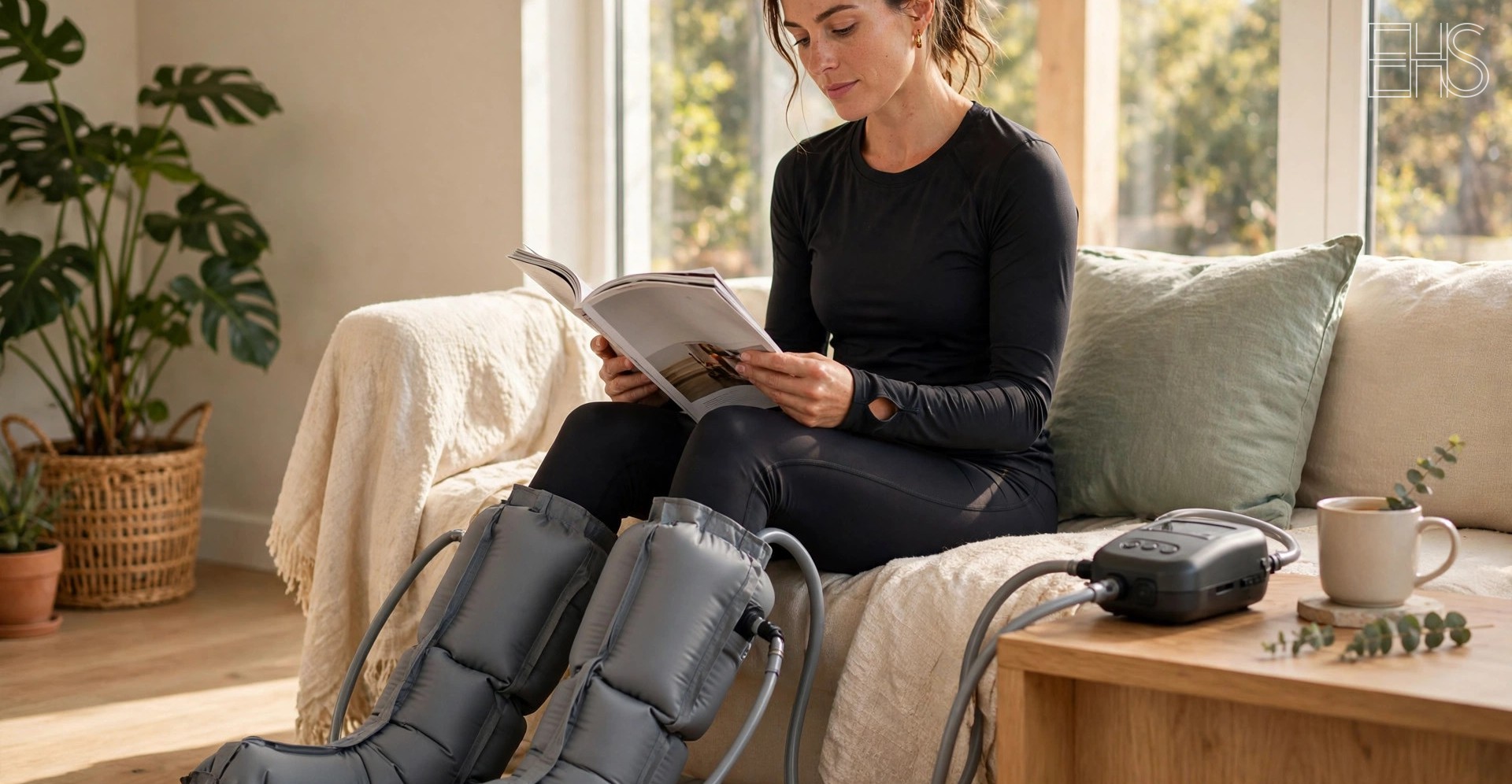
Pneumatic compression devices, usually shaped as inflatable boots, wrap the legs in air chambers that inflate and deflate in sequence, ankle to hip. The sensation is a rhythmic squeeze and release, often described as a strong hug for the legs, applied while the user reclines. Typical sessions run 20 to 40 minutes and require no effort beyond sitting still.
The mechanism is sequential pressure: chambers fill from the bottom upward, which moves fluid and blood volume in the lower limbs upward through the session. The evidence base here resembles the percussion story: small trials, short follow-ups, and a consistent pattern of users reporting that their legs feel lighter and more comfortable after sessions. Measured effects on soreness and recovery markers are inconsistent. The detailed evidence grading lives in the EverHealthSpan compression therapy evidence review.
Compression is inherently passive. The device wraps the whole leg at once, so coverage is uniform rather than targeted, and it only covers the legs. Shoulders, back, arms, and neck are outside its job description by design.
The Head-to-Head Comparison
The table below compares the two devices across the dimensions that actually determine which one fits your routine: mechanism, coverage, effort, portability, cost, and what the evidence says. The facts come from the published category data and the evidence reviews linked above, not from manufacturer marketing.
| Dimension | Percussion (massage gun) | Compression (boots) |
|---|---|---|
| Mechanism | Rapid percussive taps on muscle tissue | Sequential air-chamber squeezing, ankle to hip |
| Coverage | Targeted: any muscle you can reach | Whole-leg only: calves, quads, hamstrings |
| Your effort | Active: several minutes per muscle group | Passive: sit or recline for 20 to 40 minutes |
| Session length | 1 to 3 minutes per area | 20 to 40 minutes for a full session |
| Portability | High: handheld, battery powered, travel friendly | Low: needs the pump unit, floor space, and a power outlet |
| Noise | Audible motor hum; quieter models are conversation-compatible | Quiet pump cycling; silent enough for television |
| Price range | Roughly $60 to $600 across tiers; verify current rates before buying | Roughly $300 to $1,500+ across tiers; verify current rates before buying |
| Best evidence | Short-term range of motion; muscles feel better afterward | Muscles feel lighter and more comfortable afterward |
| Honest limit | Effects are short-term and perceptual | Effects are short-term and perceptual |
The pattern worth noticing: neither device has demonstrated durable, measured recovery effects. Both earn their place through how they feel. The buying decision is therefore about which sensation, which effort profile, and which coverage pattern matches your routine.
Which One to Reach for, by Situation
The decision matrix below maps common situations to the device that fits best. It reflects practical tradeoffs, portability, coverage, effort, rather than claimed superiority, since the evidence does not establish one as physiologically better than the other.
| Situation | The better pick | Why |
|---|---|---|
| Post-leg-day, at home on the couch | Compression boots | Full-leg passive coverage while you rest; 30 minutes of nothing required |
| Travel, hotel room, or gym bag | Massage gun | Battery powered, fits in a carry-on, works anywhere |
| Tight shoulders and desk-work neck | Massage gun | Boots do not reach the upper body at all |
| Endurance sport: runners, cyclists | Compression boots | Whole-leg treatment suits the legs, where the work happened |
| Hard-to-reach back and lats | Massage gun | Articulating and mini guns reach areas boots cannot touch |
| Relaxation ritual after training | Compression boots | The squeeze-and-release cycle is genuinely pleasant for unwinding |
| Quick session between activities | Massage gun | Two minutes on a tight calf beats setting up 30 minutes of boots |
| Budget under $200 | Massage gun | A usable mid-range gun starts near that price; boots start higher |
For people considering both, the overlap is small: one is a targeted active tool, the other a full-leg passive ritual. Match the purchase to the training volume: two to three sessions a week argues for one device; five or more, with both upper and lower body demands, argues for two.
Session Timing: How to Sequence Them
For readers who own both, sequencing matters. Percussion sits naturally right after training or before the next session: a few minutes on worked muscles, when you want a short-term mobility window. Compression sits naturally later, in the evening, as a passive wind-down.
One practical caution: do not stack every modality on the same day and call it a protocol. Devices, heat, and cold all apply stress, and more stress is not automatically more recovery. The EverHealthSpan contrast therapy protocols guide explains how to think about layering recovery inputs without overcomplicating the routine. A sensible rule is one modality per time block, and a rest day that is genuinely restful.
Safety: Who Should Be Careful
Both devices apply mechanical force to the body, and neither is for everyone. With percussion, never use the device on bony prominences, the front of the neck, or directly over the spine, and avoid varicose veins, open wounds, rashes, and areas with reduced sensation. With compression, the sustained pressure on the legs is the concern: anyone with blood-clotting conditions, circulatory or vascular conditions, or unusual leg swelling should get professional guidance before use.
Pregnant readers should get qualified guidance before using either device, and both should be kept away from children. Pain is information: aim for firm, comfortable pressure, never punishment. Start at the lowest setting on each new area, and stop if anything feels wrong.
Cost and the Value Question
Pricing in both categories spans wide ranges. Massage guns typically run from around $60 at the budget end to $600 or more for professional tools, with the mid-range sweet spot between roughly $150 and $350. Compression boots typically start around $300 and climb past $1,500 for pro-grade systems with app control and multiple attachments. Prices move with frequent promotions, so verify current rates before buying.
The value question comes down to use frequency, not features. A $150 massage gun used three times a week is worth more than a $900 system used twice a month. Before buying either, be honest about the routine it demands: percussion asks for active minutes and hand effort; compression asks for 30 still minutes on the floor. Buy the one whose routine you actually follow.
The real ongoing cost is attention: both devices only deliver if used, and consistency matters more than tier.
Frequently Asked Questions
Can I use both a massage gun and compression boots, or is that overkill?
Both is reasonable if your training pattern supports both: percussion for targeted work and portability, compression for full-leg passive sessions. The overlap is small enough that they do not duplicate each other. What qualifies as overkill is buying both when you train casually twice a week. Match the purchase to the training volume: two to three sessions a week argues for one device; five or more, with both upper and lower body demands, argues for two.
Which one is better for post-run legs specifically?
Compression boots, on balance. Running loads the whole lower leg uniformly, and boots treat the whole lower leg uniformly while you sit still, which matches the situation. Percussion still has a role for specific tight spots, a knot in a calf, an angry IT band area, but for the general post-run leg feeling, boots are the more natural fit. Either way, the effect is short-term comfort, not measured acceleration of recovery.
Do compression boots replace stretching or mobility work?
No. Compression is a passive sensation, not a movement practice, and it does not improve range of motion the way active mobility work does. Percussion has somewhat better support for short-term range-of-motion changes, but neither replaces the habit of moving joints through their ranges under control. Think of the devices as comfort layers on top of movement, not substitutes for it.
How long should a compression boot session last?
Most consumer systems suggest 20 to 40 minutes, and that range reflects the design more than a dosing study: shorter sessions feel incomplete, longer ones reach diminishing returns on comfort. Start at 20 minutes on a moderate pressure setting and adjust from there. The session should feel like a firm, pleasant squeeze; numbness or tingling means the pressure is too high.
Is a massage gun safe on a bruise or a fresh strain?
No. Percussion on bruised, swollen, or freshly strained tissue is a bad idea; the mechanical force irritates damaged tissue and can make the situation worse. Wait until the acute tenderness and visible swelling have fully resolved, and return at the lowest setting on the surrounding muscles first. Compression boots carry the same caution for the legs: do not compress an injured limb. When in doubt about an injury, get professional guidance before applying any device to it.
Do these devices actually speed recovery, or just feel good?
The honest answer is the second, with a caveat. Small trials have found short-term effects, range-of-motion windows after percussion, comfortable legs after compression, but consistent evidence of accelerated recovery physiology, measured through soreness, performance, or biomarkers, is missing. The devices earn their price through sensation, convenience, and the ritual of doing something for recovery. Buy them for that, with eyes open, and they are reasonable purchases.
This article is for informational purposes only and does not provide medical advice or guaranteed outcomes.