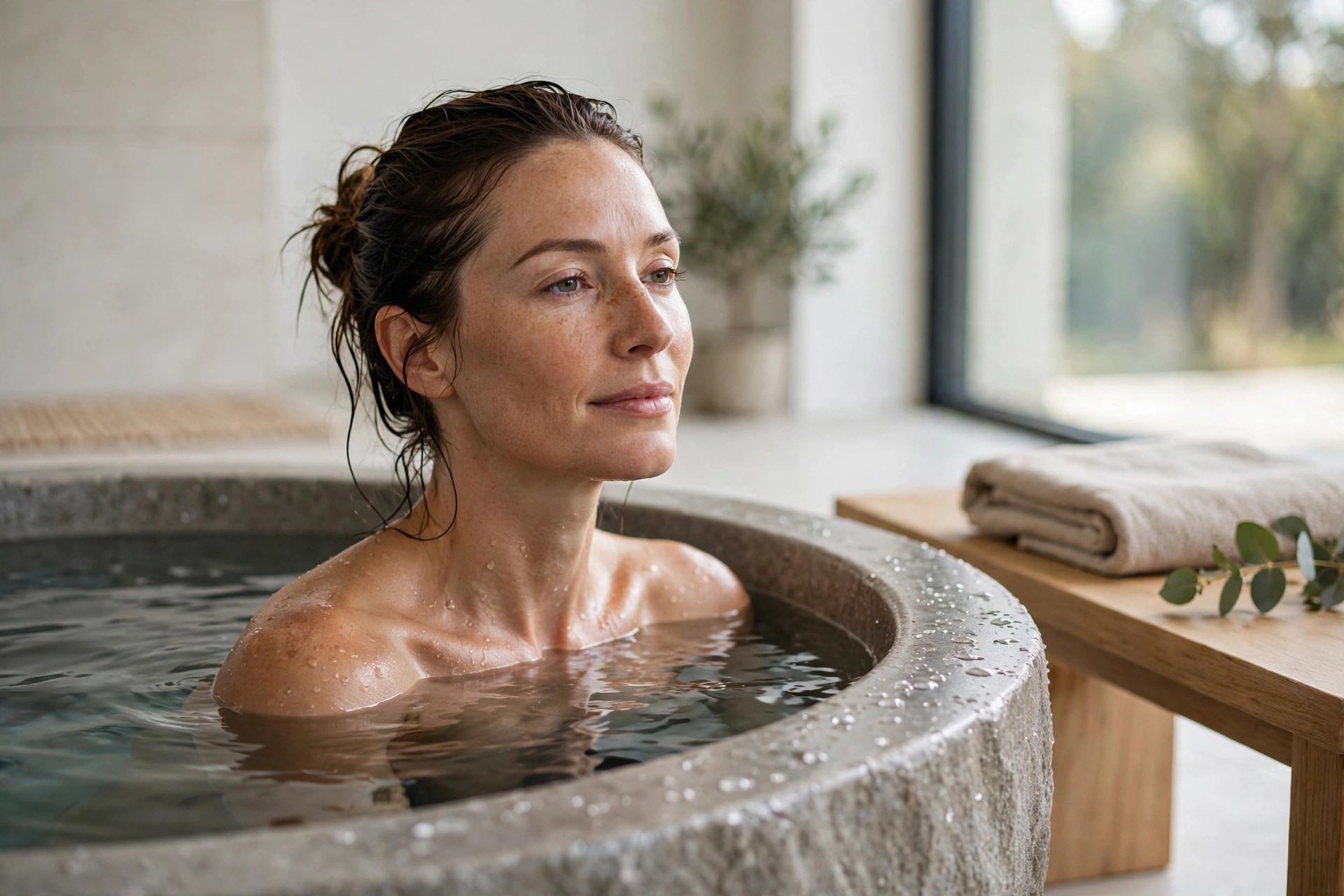
Everyone obsesses over the tub and the chiller. Almost nobody thinks about the water until it turns cloudy, starts smelling faintly like a pond, or grows a slick film on the walls. Water care is the unglamorous half of cold plunge ownership — and it's the part that determines whether plunging stays a pleasure or becomes a chore.
Cold water slows bacterial growth, but it doesn't stop it. Every session adds body oils, sweat, sunscreen, and whatever was on your skin into 80 to 150 gallons of water. Without a plan, that water needs dumping every few days. With one, it can stay clear and clean for weeks or even months. This guide covers the full system: chillers versus ice, filtration, sanitizers, and the schedules that actually work.
Why Water Care Is the Real Cost of Plunging
A cold plunge is essentially a very small, very cold swimming pool that you sit in with your entire body. Pools stay clean through constant filtration, circulation, and chemical treatment. Most plunge setups — especially ice-based ones — have none of that. The result is predictable: organic matter accumulates, biofilm forms on surfaces, and water quality declines fast.
The math is simple. One person brings a meaningful contaminant load per session. Two people plunge daily and you're adding fourteen sessions' worth of skin cells, oils, and residue per week into a small volume of water. Cold temperatures buy you time compared to a hot tub, but they don't buy you a pass. Owners who ignore water care end up doing emergency water changes at 10 p.m. on a Tuesday — or worse, they stop plunging because the tub always looks uninviting.
The good news: a basic system isn't complicated or expensive. It has three parts — keep particles out, kill what's growing, and replace water on a schedule before problems start.
Ice vs. Chiller: Two Different Water Realities
Your cooling method largely determines your water-care burden.
Ice setups have no circulation and no filtration. Water sits stagnant between sessions, and melting ice constantly dilutes whatever sanitizer you've added. This is the highest-maintenance configuration: plan on full water changes every 2 to 4 days with regular use. You can stretch this slightly with sanitizers, but without circulation they distribute unevenly and degrade fast.
Chiller setups circulate water continuously through the cooling unit, and most chillers include at least a basic particulate filter. Circulation alone is a major upgrade — moving water resists stagnation and distributes sanitizer evenly. Typical water-change intervals stretch to 2 to 6 weeks, and with added sanitation (ozone or UV) some owners go 2 to 3 months.
If you're choosing between the two approaches, our buyer's guide to cold plunge tubs breaks down the tiers in detail, and our chiller versus ice comparison runs the full cost math.
Filtration: Your First Line of Defense
Filtration removes particles — skin cells, hair, dust, debris — before they break down into the dissolved organic matter that feeds bacteria and clouds water. It does not sanitize. Clear water is not necessarily clean water, but dirty water is never clean, so filtration is always step one.
Cartridge filters are the standard in chiller setups. Most use a 20-micron pleated cartridge that catches visible particles. Rinse the cartridge weekly under a hose, deep-clean it monthly, and replace it every 3 to 6 months depending on use. Replacements typically cost $30 to $80. This is the quiet recurring expense of plunge ownership — budget for it.
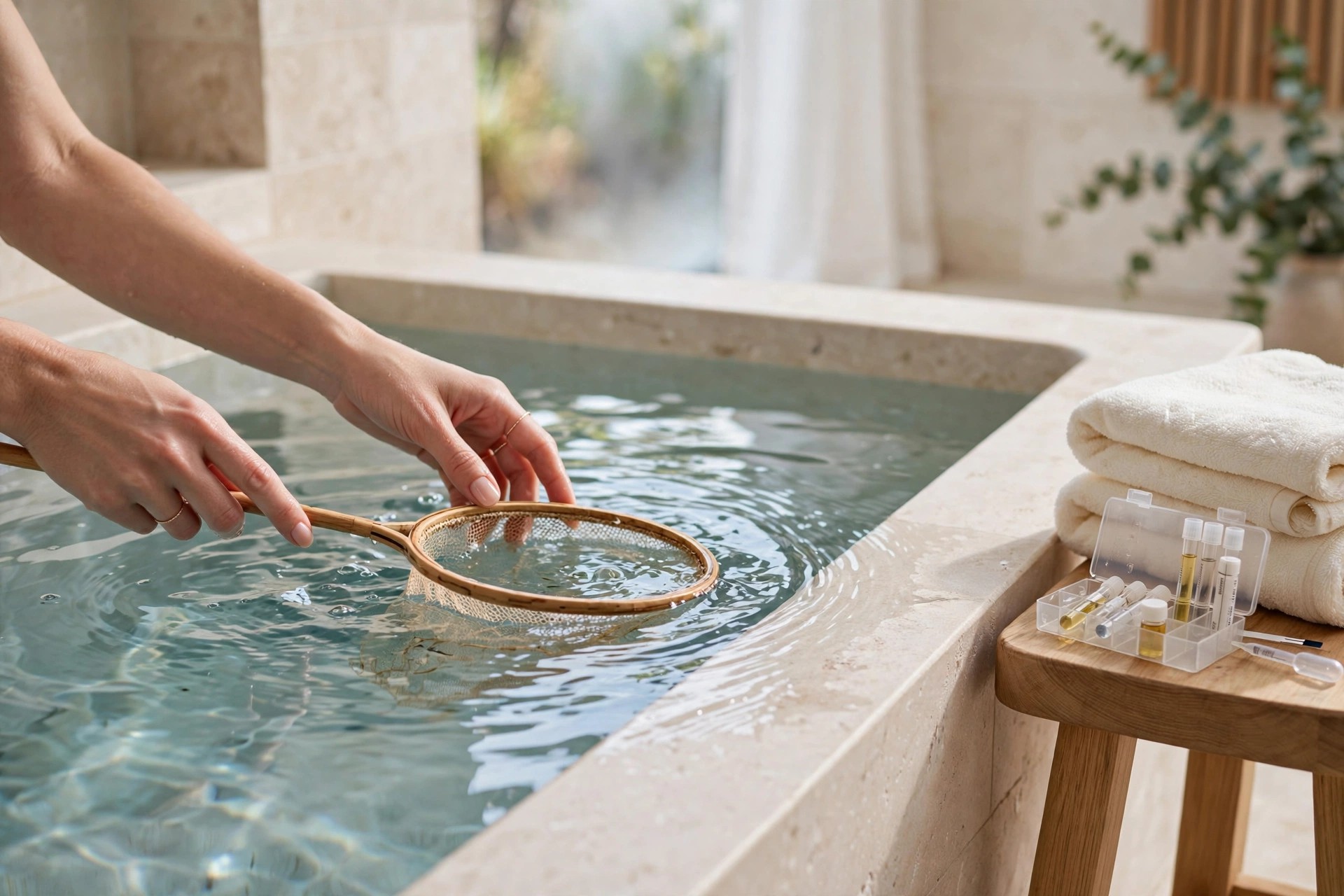
Skimmer nets and pre-filters handle what cartridges miss. A small hand skimmer takes ten seconds after each session and removes floating debris before it sinks and decays. A hose pre-filter (around $20 to $40) on your fill hose removes sediment and some minerals from tap water at fill time, which meaningfully extends the life of each fill.
What filtration can't do: remove dissolved contaminants, kill bacteria, or fix water that's already turned. If the water is green or smells off, no amount of filtering saves it — drain, scrub, and refill. Filtration is prevention, not treatment.
Sanitizers Compared: What Actually Works
Sanitizers kill microorganisms. In a plunge, you're choosing between effectiveness, convenience, material compatibility, and how much chemical exposure you want in water you submerge your face in.
| Sanitizer | How it works | Pros | Cons |
|---|---|---|---|
| Hydrogen peroxide | Oxidizer; breaks down into water and oxygen | No harsh smell, gentle on tub materials, widely used in plunge community | Needs regular dosing, degrades in light/heat, requires test strips to dose correctly |
| UV sterilizer | Inline lamp kills microbes as water passes | No chemicals added to water, low ongoing effort | No residual protection — only treats water passing through the lamp; bulbs need yearly replacement (~$40–$80) |
| Ozone generator | Powerful oxidizer injected into circulation | Very effective, reduces or eliminates chemical dosing, keeps water exceptionally clear | Higher upfront cost ($150–$400 add-on), needs proper installation, ozone gas itself is an irritant if not properly dissolved |
| Bromine/chlorine | Traditional pool/spa sanitizers | Cheap, effective, well understood | Harsh at plunge concentrations, strong smell, can degrade vinyl and seals, unpleasant in a small unventilated tub |
Hydrogen peroxide is the most common choice for home plunges. Food-grade or spa-formulated peroxide is dosed in small amounts — typically a few ounces per hundred gallons — and maintained with test strips. It breaks down into water and oxygen, so there's no chemical buildup. The catch: it degrades over days, so it needs re-dosing on a schedule, and it works best in water that's already filtered.
UV and ozone are the "install and forget" options, and they pair well together — ozone provides residual oxidation while UV sterilizes the circulating flow. Both are add-ons to chiller setups rather than standalone solutions for ice tubs, since they need circulation to work.
What to skip: household bleach in vinyl or inflatable tubs (it degrades the material and the dosing is unforgiving at small volumes), copper/silver "mineral" sticks as your only sanitizer (mild supplemental effect at best), and essential oils marketed as sanitizers (they scent the water; they don't sanitize it).
Water-Change Schedules That Actually Work
Forget rigid calendars. Change water based on your setup and load, using these intervals as starting points:
| Setup | Typical interval | Stretch it by |
|---|---|---|
| Ice, no filtration | Every 2–4 days | Showering first, covering the tub, fewer users |
| Chiller + basic filter | Every 2–4 weeks | Peroxide dosing, pre-shower, indoor placement |
| Chiller + filter + ozone or UV | Every 6–12 weeks | Same as above, plus regular filter cleaning |
Three factors matter more than the calendar: number of users (each additional daily user roughly halves water life), pre-session showers (the single highest-impact habit — a 30-second rinse removes most of the contaminant load), and sunlight and heat (outdoor tubs in sun grow things faster; keep the cover on).
When in doubt, trust your senses over the schedule. Cloudy water, any smell, or a slippery feel on the tub walls means change it now, regardless of what the calendar says.
The Routine: Daily, Weekly, Monthly
Water care takes about five minutes a week once it's a habit:
After each session: Skim floating debris. Replace the cover — this keeps out dust, leaves, and sunlight, and it's the easiest win in all of water care.
Weekly: Rinse the filter cartridge. Check sanitizer levels with a test strip and dose as needed. Wipe the waterline with a clean cloth — the ring that forms there is biofilm getting started.
Monthly: Deep-clean or soak the filter cartridge. Check hoses and connections for buildup. If water is approaching the end of its interval, plan the change rather than pushing it.
At each water change: Drain fully, scrub all surfaces with a soft brush and a mild non-abrasive cleaner, rinse thoroughly, and refill. This is also the moment to inspect seals, the cover, and chiller connections.
Five Mistakes That Turn Water Green
- Skipping the pre-shower. Sunscreen, lotion, and deodorant are water-care poison. A quick rinse takes 30 seconds and doubles water life.
- Leaving the cover off. Sunlight plus still water is an algae invitation. The cover is not optional.
- Dosing sanitizer once and forgetting it. Peroxide degrades; a single dose at fill time protects you for days, not weeks. Test weekly.
- Never cleaning the filter. A clogged filter is worse than no filter — it becomes a bacteria hotel recirculating into your tub.
- Topping off instead of changing. Adding fresh water to dirty water just makes slightly diluted dirty water. When it's time, drain fully.
Frequently Asked Questions
Can I use chlorine in my cold plunge?
You can, but most owners regret it. At the small volumes of a plunge tub, chlorine dosing is unforgiving — slightly too much and the water reeks and irritates skin and eyes; the smell is much stronger than in a pool because the water volume is small and often indoors. Chlorine also degrades vinyl liners, inflatable materials, and rubber seals faster. Hydrogen peroxide, UV, or ozone are generally better fits for plunge-sized bodies of water.
How do I know when it's time to change the water?
Trust your senses: cloudiness you can't filter out, any unpleasant smell, or a slippery/slimy feel on the tub walls all mean change it now. Test strips showing sanitizer at zero despite recent dosing is another signal — it means the organic load has overwhelmed your treatment. Don't wait for visible algae; by then you're overdue.
Is hydrogen peroxide safe for plunge water?
Yes, when dosed correctly — it's one of the most widely used sanitizers in the home plunge community. It breaks down into water and oxygen, leaving no harsh residues. Use spa-formulated or food-grade peroxide, follow dosing guidance for your tub's volume, and verify with test strips rather than guessing. Keep it stored away from light and heat, as it degrades over time even in the bottle.
Do I really need to shower before every plunge?
It's the highest-impact habit in water care, and it takes 30 seconds. A quick rinse removes sunscreen, lotion, deodorant, sweat, and surface oils — the bulk of what fouls plunge water. Owners who shower first consistently report doubling or tripling their intervals between water changes. If you'll do one thing from this guide, do this.
Why is my water cloudy even though I have a filter?
Cloudiness with a working filter usually means one of three things: the filter cartridge is clogged and needs rinsing or replacing, the cloudiness is dissolved (not particulate) matter that no filter can catch — in which case sanitizer levels are likely low — or the water is simply at the end of its life and needs changing. Check in that order: rinse the filter, test and dose sanitizer, and if it's still cloudy after 24 hours of circulation, drain and refill.
Can I fill my plunge with regular tap water?
Yes — tap water is what nearly everyone uses. A hose pre-filter (around $20 to $40) is worth adding at fill time to catch sediment and reduce minerals, especially if you have hard water. Avoid softened water if you can; it's more corrosive to metal components. Well water should be tested first, as iron and sulfur content can stain tubs and complicate sanitation.
This article is for informational purposes only and is not medical advice. Consult a qualified professional before making health decisions.