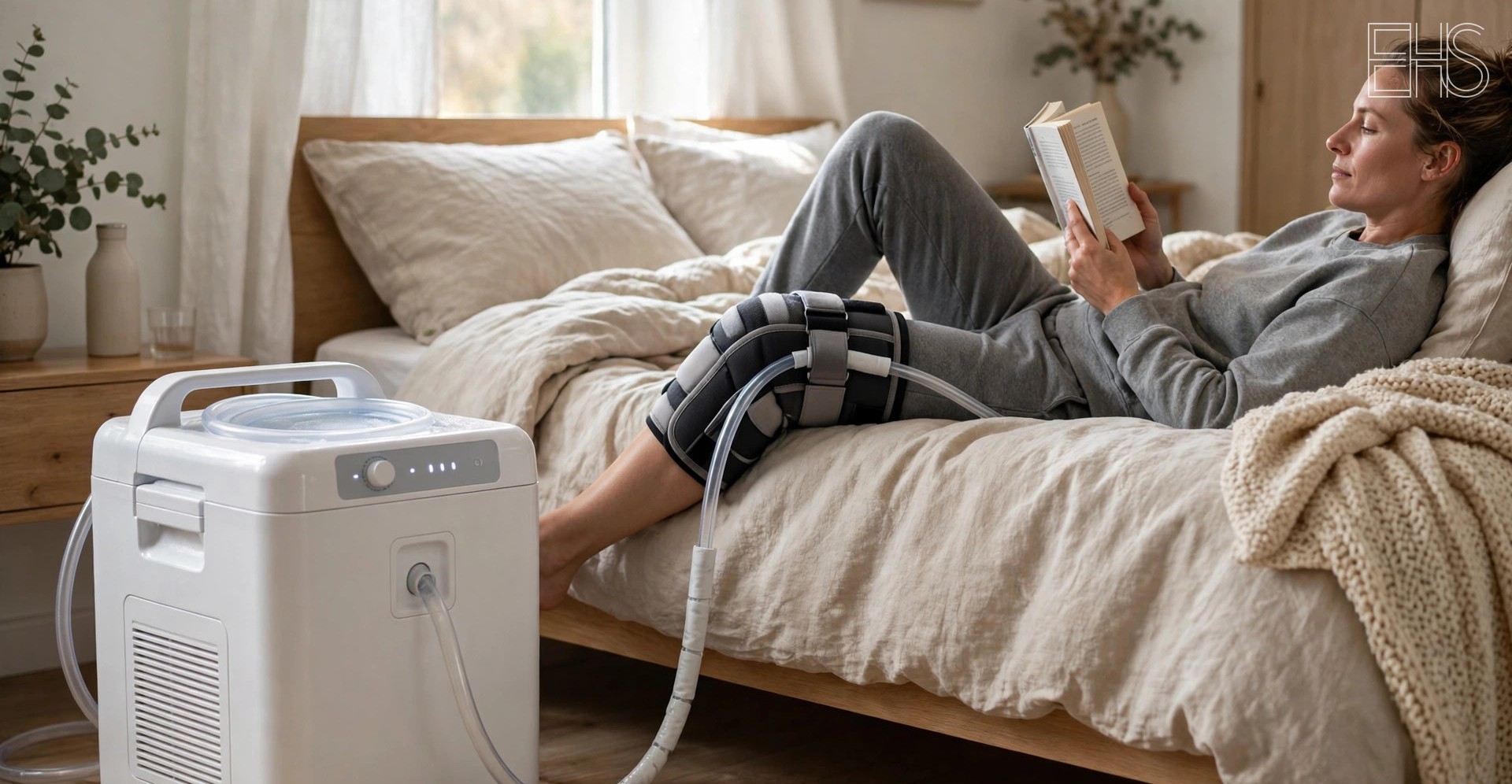
After a knee replacement or a torn ligament, the first week at home revolves around ice and elevation. A bag of frozen peas works for an afternoon, not for a week of around-the-clock icing. A cold therapy machine fills that gap: a small cooler, a pump, a hose, and a wrap shaped for the joint. Fill it with ice and water, strap the wrap on, and chilled water circulates until the ice runs out.
Key takeaways - A cold therapy machine circulates ice water through a fitted wrap, replacing the cycle of refreezing gel packs and repositioning bags of ice. - Compression is the dividing line: Game Ready and the Breg Polar Care Wave add active pneumatic squeezing, while budget units deliver cold only. - Game Ready GRPro 2.1 is the reference machine, with a control unit listed at around $3,037 and sold in the United States as a prescription device. - For a single surgery, renting a Game Ready for one week at $329 often costs less than buying.
What a Cold Therapy Machine Actually Does
Every machine here does the same basic job: it keeps cold water moving against one body part. The cooler holds ice and water, the pump pushes it through a tube into the wrap, and the wrap holds it against the skin. The differences are compression, cold duration, and temperature control.
Cold-only machines, such as the DonJoy IceMan and Ossur Cold Rush, circulate water and nothing else; the only pressure comes from the strap. Cold-plus-compression machines, the Breg Polar Care Wave and Game Ready GRPro 2.1, inflate chambers inside the wrap on a cycle, squeezing and releasing. That separates a $300 machine from a $3,000 one. These machines are not cold plunges; the evidence for whole-body cold exposure is covered in the EverHealthSpan cold plunge benefits evidence review. For whole-body cold exposure rather than targeted joint icing, a plunge tub is a different category: Renu Therapy's Cold Stoic 2.0 (affiliate link) is an insulated tub with an integrated chiller, listed at $9,499.
Game Ready GRPro 2.1: The Clinic Standard at Home
Game Ready is the name that comes up in every locker room and orthopedic ward, and the GRPro 2.1 is the current model. It pairs a control unit with anatomical ATX wraps, combining adjustable cold with programmable intermittent compression, and holds cold between 35 and 50 degrees Fahrenheit with a full reservoir.
The price is the story: at OrthoBracing, the control unit alone is listed at $3,037.39, a system with one wrap runs from around $3,037 to $3,580, and wraps are sold separately at around $384 to $542 each. Game Ready is a prescription device in the United States. It also rents directly, from $329 for one week, with extensions at $150 per week.
Breg Polar Care Wave: Cold Plus Compression for a Tenth of the Price
The Breg Polar Care Wave is the machine most buyers should look at first: motorized cold with active pneumatic compression in a compact cooler. At OrthoBracing, the Wave is listed at $285 for the cooler alone, $389 with one pad, and $589 for a bilateral knee kit. Its compression is simpler than Game Ready's, with two settings, low and regular, and one fill lasts 6 to 8 hours. The Wave is also a prescription device in the United States.
DonJoy IceMan Classic3 and CLEAR3: The Budget Workhorses
DonJoy's IceMan line has been the default budget pick for years: the Classic3 and CLEAR3 are both cold-only machines, a cooler, a quiet pump, and a wrap-on pad, with no compression beyond the strap. The Classic3 adds temperature control; the CLEAR3 uses a see-through cooler. At OrthoBracing, the Classic3 cooler is listed at $169.99 and the CLEAR3 at $149.99, with pads adding around $40 to $70, so a complete system lands at around $190 to $210. Opened units are typically final sale, so check the sizing chart before ordering.
Ossur Cold Rush: Quiet and Light
The Ossur Cold Rush is the quietest machine in this guide and the lightest motorized one at 4.6 pounds. It is a cold-only unit with a stronger flow rate than the best-selling budget machines. The unit alone is listed from around $150, a system with one pad from around $190 to $200. With neither temperature control nor compression, the choice comes down to noise and weight.
Aircast Cryo Cuff: No Motor, No Outlet
The Aircast Cryo Cuff is the outlier because it has no motor at all: the gravity-fed version is a cooler, a tube, and an anatomically shaped cuff. Raise the cooler to fill the cuff with chilled water, lower it to refresh the water, and the cuff provides gentle focal compression as it fills. There is no pump hum, no power outlet, and nothing to break. One fill lasts 6 to 8 hours. A complete system runs from around $120 to $190 depending on the body part. The tradeoff is control: a gravity system cannot adjust temperature or pressure.
The Comparison, Side by Side
Prices below are listed at OrthoBracing in November 2026; verify current rates before buying.
| Machine | Compression | Price with one wrap or pad | Cold per fill | Standout feature |
|---|---|---|---|---|
| Game Ready GRPro 2.1 | Intermittent pneumatic, adjustable | Around $3,037 to $3,580 | Ice refill as needed | Programmable cold plus compression, clinic standard |
| Breg Polar Care Wave | Active pneumatic, low or regular | Around $285 to $589 | 6 to 8 hours | Cold plus compression near a tenth of Game Ready |
| DonJoy IceMan Classic3 / CLEAR3 | None, cold only | Around $150 to $210 | Ice refill as needed | Temperature control on Classic3, lowest priced motorized units |
| Ossur Cold Rush | None, cold only | Around $150 to $200 | Longer than most budget units | Quietest motor, lightest at 4.6 pounds |
| Aircast Cryo Cuff (gravity) | Gentle focal compression from water fill | Around $120 to $190 | 6 to 8 hours | No motor, no outlet, silent |
Compression is what you pay for: cold alone costs $120 to $210, cold plus active compression starts at $285 with the Wave and jumps past $3,000 with Game Ready.
Whole-Body Cold Is a Different Purchase
A machine ices one joint; a plunge tub immerses the whole body. The two solve different problems, and are priced accordingly: machines here run from around $120 to $3,580, while Renu Therapy's Cold Stoic 2.0 (affiliate link), an insulated tub with an integrated chiller, is listed at $9,499. A tub needs a permanent spot; a machine lives in a closet.
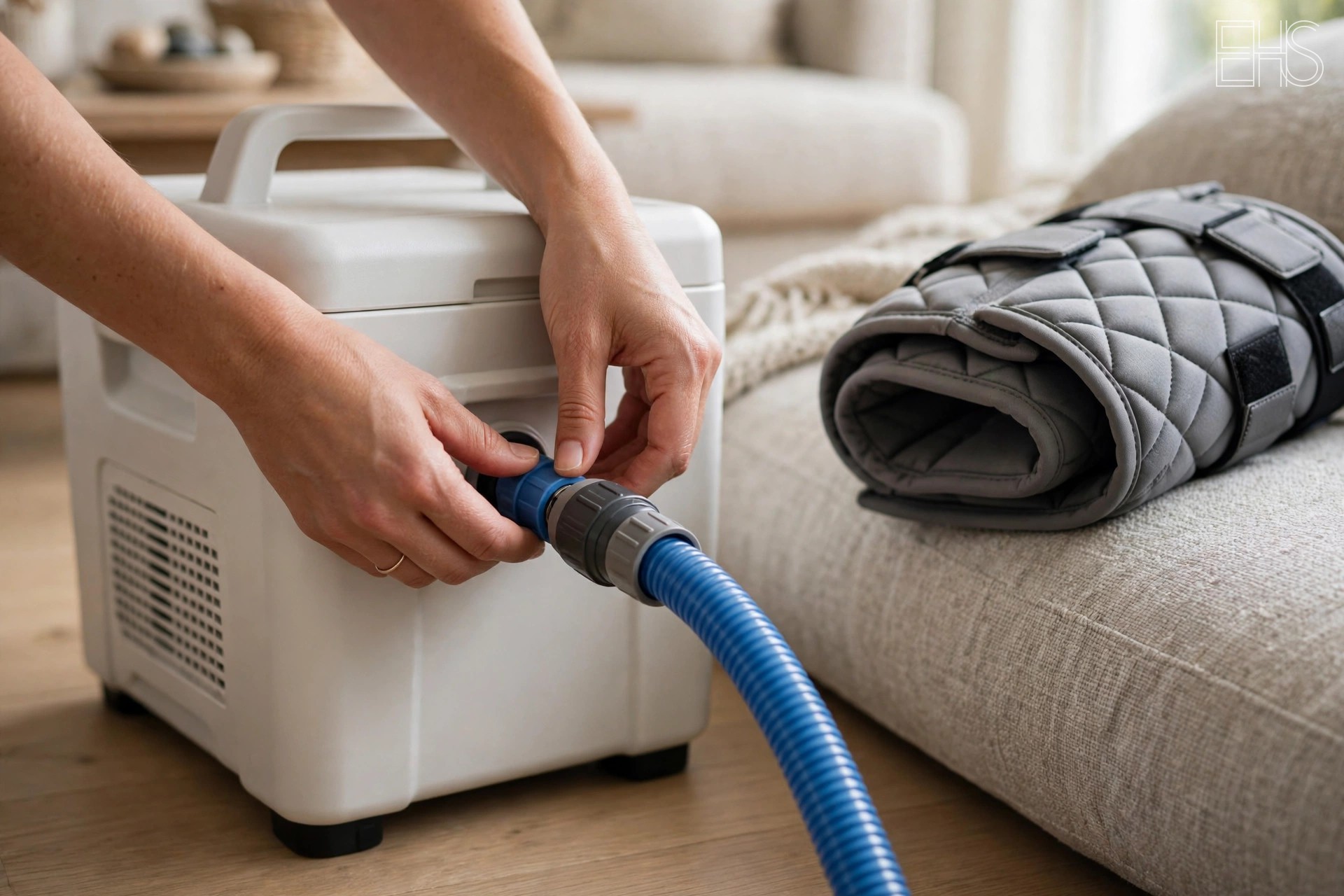
Illustration by EverHealthSpan
Rent or Buy: The Math That Decides It
Rent or buy decides more purchases than any feature comparison, because most buyers need a machine for weeks. Game Ready's published rental menu sets the benchmark: one week at $329, two weeks at $479, and one month at $699. A three-week window rents for $479, against $3,037 to buy.
Buying wins when the machine will see repeat use: a DonJoy IceMan at around $200 costs less than one week of Game Ready rental.
What to Check Before You Buy
Four details cause most buyer's remorse. First, wrap fit: measure the joint the sizing chart asks for and order the size it indicates, since a loose wrap leaks cold water, a tight one restricts circulation, and opened units are typically final sale. Second, ice supply: without a large freezer, plan on frozen water bottles in rotation. Third, noise and power: the Cold Rush and gravity Cryo Cuff are the quiet options. Fourth, the fine print: Game Ready and the Breg Wave are sold as prescription devices in the United States, so confirm the requirement with the seller and check the warranty. For more on compression devices, see percussion vs. compression recovery and compression therapy evidence review.
A Plain-English Safety Note
Cold and pressure are not for everyone. Never fall asleep with a cold therapy unit running unless the instructions that come with your unit say that is safe, and always place a thin barrier, such as a T-shirt or a towel, between pad and bare skin. Check the skin under the wrap each time you change the ice: numbness, skin that stays pale or blotchy, or pain that grows instead of easing are all reasons to stop. Anyone with circulation or clotting conditions, unusual swelling, reduced sensation, or an open wound should get professional guidance before using one. More cold-exposure safety principles are in the cold plunge safety guide.
Frequently Asked Questions
Is a Game Ready machine worth it for a single knee surgery?
For most single surgeries, renting beats buying. A two-week Game Ready rental is listed at $479, while buying the control unit alone is listed at around $3,037, before wraps. The rental includes the correct wrap and collection at the end. Buying only makes sense if a second surgery is already planned or the machine will serve a household with ongoing needs.
Do cold therapy machines replace ice packs?
They replace the routine of ice packs, not the cold itself. A machine holds a steady temperature against the joint for hours without the cycle of freezing, wrapping, and repositioning gel packs. For a minor bump, a gel pack is still the simpler tool. For a joint that needs cold several times a day for a week or more, the machine earns its place. They also do not replace whole-body cold exposure. That is a cold plunge, a separate category, and Renu Therapy's Cold Stoic 2.0 (affiliate link) is an insulated tub with an integrated chiller.
How long should a cold therapy session last?
Most manufacturers suggest sessions of around 20 to 30 minutes, several times a day; follow the instructions that come with your unit. The wrap should come off regularly so the skin can be checked and warmed. If the area goes numb or the skin stays pale after the wrap comes off, stop and warm it up.
Can I use a cold therapy machine for a sprain or a sports injury, not just after surgery?
Yes, these machines are used for sprains, strains, and training injuries as well as post-surgical recovery: a wrap on the injured area, ice water circulating, and sessions spaced through the day. A sprain usually needs days of cold rather than weeks. Anyone with an injury that is worsening or unusually swollen should get professional guidance before continuing to use the machine.
What is the difference between cold-only machines and cold-plus-compression machines?
Cold-only machines, such as the DonJoy IceMan and Ossur Cold Rush, circulate chilled water and rely on the strap. Cold-plus-compression machines add a squeezing mechanism: the Breg Polar Care Wave and Game Ready inflate chambers inside the wrap on a cycle, while the Aircast Cryo Cuff uses the water fill itself for gentle focal compression. Compression models cost more, from around $285 for the Wave to more than $3,000 for Game Ready.
Do I need a prescription to buy a cold therapy machine?
It depends on the machine. Game Ready and the Breg Polar Care Wave are sold in the United States as prescription devices, and some sellers require a prescription on file, so confirm with the seller before ordering. Budget machines, including the DonJoy IceMan, Ossur Cold Rush, and the gravity-fed Aircast Cryo Cuff, are generally sold without one. Rules differ between sellers, so the seller's product page is the reliable source.
This article is for informational purposes only and does not provide medical advice or guaranteed outcomes.