The hardest part of a cold plunge is rarely the cold itself. It is the first minute, when the water hits your chest and breathing turns fast and shallow. Most people who quit do so because nobody showed them what to do with their breath in those opening seconds, not because the water was too cold.
Breathing is the skill that makes the rest of the practice possible. A person breathing slow and steady at 12C can sit calmly, while a person gasping at 15C is already counting the seconds to climb out. The techniques here are simple and cost nothing, and they work the same in a tub, a cold pool, or a shower.
The cold plunge safety guide sets out who should skip cold immersion altogether. A word of caution first: cold water immersion suits some people, not others. Begin gently, keep early sessions brief, and take any day off when unwell. Climb out immediately if dizziness, confusion, or uncontrolled breathing appears, and skip sessions after alcohol or when the feeling is anxiety, not simple reluctance.
Key takeaways - The gasp reflex peaks in the first 30 to 60 seconds, then fades: ride it out. - Make the exhale longer than the inhale: a slow out-breath steadies your breathing fastest. - Practice the pattern on dry land first, so it is automatic before the water hits. - Never hyperventilate before getting in, and never hold your breath under water.
Why the First Minute Feels Impossible
Cold water on the skin triggers a reflex researchers call the cold shock response. The body reads sudden cold as an emergency: breathing speeds up, the heart rate climbs, and the chest tightens. The gasp reflex is the most visible part, an involuntary sharp inhale the moment cold water reaches the torso. It is the standard response, strongest in newcomers.
The useful fact is that the response fades. In most people, breathing starts to settle within 60 to 90 seconds as the body registers that the cold is not getting worse. Keep your breathing under some control for the first minute, and the rest of the session is usually manageable. Lose control in that first minute, and the whole session feels like a struggle, which makes the next one harder to start.
This is why breathing technique matters more than toughness. Willpower does not slow a gasp reflex, but a practiced exhale does. Regular plungers have simply learned a sequence: enter on an exhale, keep the out-breath long, and let the inhale take care of itself.
The Slow Exhale: Where Every Session Starts
The single most useful technique in cold water is the extended exhale: in for a count of three or four, out for a count of six or eight, and repeat. The ratio matters more than the exact numbers. A long, slow out-breath is associated with a calmer state, while a long in-breath does the opposite.
Practice it on dry land before you ever use it in water. Sit somewhere comfortable, breathe in through your nose for a count of four, and breathe out through pursed lips for a count of eight, as though blowing through a narrow straw. Two minutes a day for a week makes the pattern automatic, which matters because the first minute of a plunge leaves no spare attention for learning.
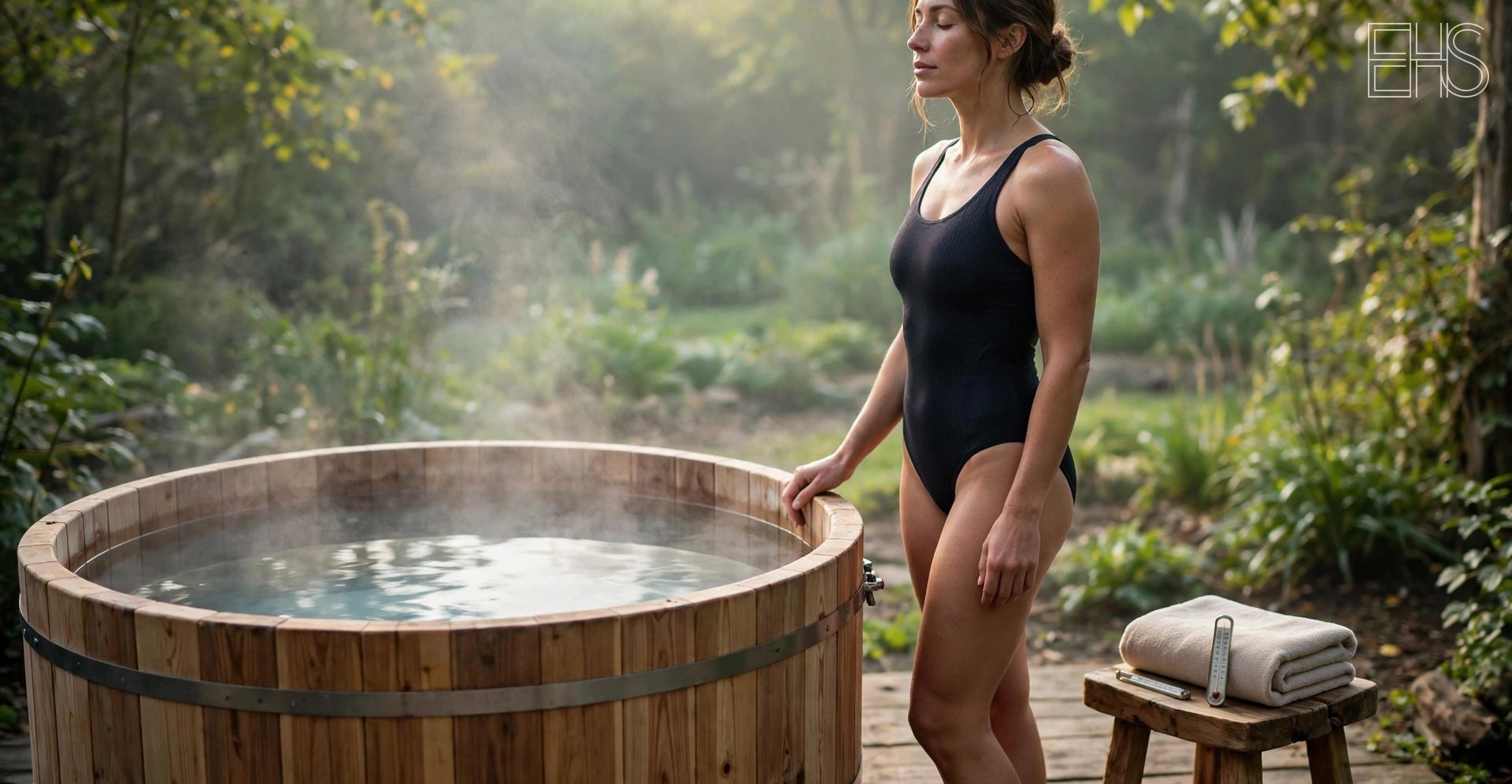
On plunge day, start the pattern before you get in: three slow breaths beside the tub, then step in on an exhale, which keeps the chest from locking up. Once seated, count the exhales: ten slow exhales is roughly a minute, and for most beginners the gasp reflex has faded by then. Keep the breaths quiet and unforced. If your breathing has not settled after 90 seconds, the water is too cold for today.
Four Breathing Techniques, Compared
The table below compares the four breathing patterns people actually use in cold water. The cold shock response itself is well documented, while the patterns come from breathwork traditions and from what regular plungers report.
| Technique | Pattern | Suited to | Keep in mind |
|---|---|---|---|
| Extended exhale | In for 4, out for 6 to 8 | The first minute | Keep it quiet, not deep |
| Box breathing | In for 4, hold for 4, out for 4, hold for 4 | Before entry | Never use under water |
| Double inhale, long exhale | Two short inhales, one long slow exhale | Resetting a gasp | One per breath is enough |
| Nasal breathing | In and out through the nose only | After the first minute | Do not force it |
Extended exhale is the default: learn it first, and return to it whenever the others stop working. Box breathing is best used before entry: four counts in, four held, four out, four held, repeated for a minute or two beside the tub. Do not hold your breath once submerged; the holds belong on dry land. The double inhale with a long exhale resets a gasp that has already started: two short sniffs in, then one long, slow exhale. Nasal breathing is the finishing technique: once the gasp reflex has passed, it keeps the rhythm slow. Do not force it in the first minute, when the mouth takes over and fighting that only adds tension.
Avoid rapid cyclic breathing before entry: the fast, forceful routines shared in online videos can leave you lightheaded as the cold hits, and lightheadedness in cold water is a real hazard. If a routine leaves you dizzy on dry land, it has no place beside a tub.
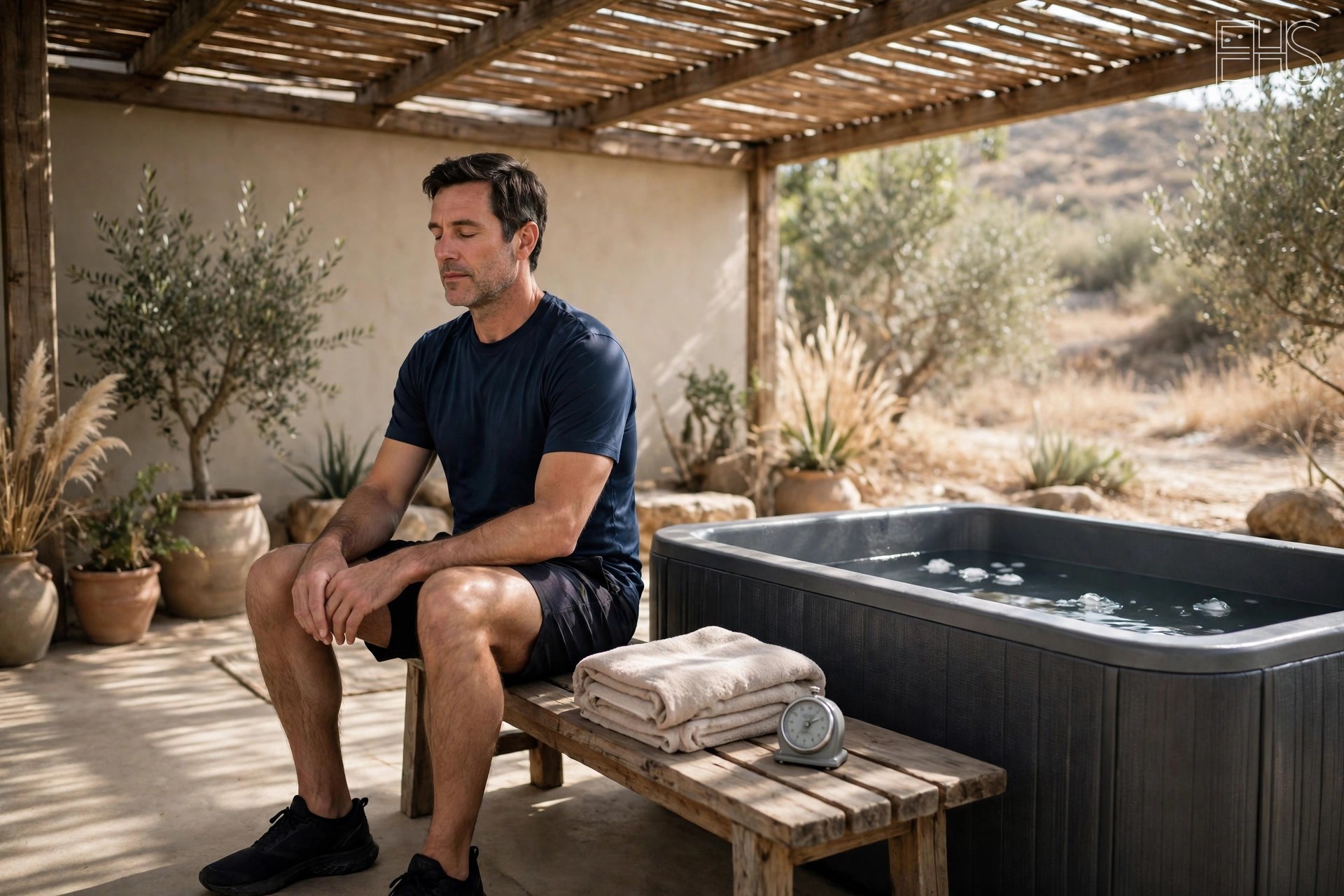
Illustration by EverHealthSpan
A Four-Week Breathing Practice Plan
Breathing skill improves the same way the rest of the practice does: gradually, one variable at a time. The plan below pairs each week with a breathing focus, and it assumes you are following a sensible temperature and duration progression, such as the one in our beginner protocol.
| Week | Water and time | Breathing focus | What changes |
|---|---|---|---|
| Week 1 | 15C to 16C (59F to 61F), 30 to 60 seconds | Extended exhale, practiced on land | Gasp reflex arriving, then fading |
| Week 2 | 13C to 15C (55F to 59F), 60 to 90 seconds | Box breathing before entry | Breathing settling faster |
| Week 3 | 11C to 13C (52F to 55F), 90 seconds to 2 minutes | Double inhale as a reset | Reset working first try |
| Week 4 | 10C to 12C (50F to 54F), 2 to 3 minutes | Nasal breathing once settled | Steady rhythm, no counting |
Week one is about the entry: practice the extended exhale on land, then use it in the water at 15C. Week two adds box breathing before entry. Week three is where the double inhale earns its place, at 11C to 13C. Week four brings the routine together: colder water, longer sessions, breathing as a background skill. What research says so far: a 2025 review (Cain and colleagues, 11 studies, 3,177 participants) found short-term mood and stress associations, with longer-term effects still uncertain. Our evidence review grades each claim.
Setting Up for Practice
Your setup shapes how easy the breathing feels. A tub that holds a steady temperature keeps conditions the same every session, so the breathing is the only variable changing. A tub filled with bagged ice drifts warmer while you sit in it, which is fine for testing the habit but makes it harder to tell whether your breathing improved or the water warmed up. Our guide to choosing a cold plunge compares the options. The table below sets out the same choice in terms of breathing practice.
| Option | Typical cost | Temperature control | Why it helps practice |
|---|---|---|---|
| Ice, a stock tank, or a barrel | Low, plus ice | Manual, drifts warmer | Testing the habit |
| Inflatable tub, ice-filled | A few hundred dollars | Manual, drifts warmer | Small spaces |
| Chilled tub, such as the Renu Vero (affiliate link) | Listed from about $7,200 | Holds a set temperature | Same water every session |
| Cold shower | Free | Limited, rarely below 15C | Sensation only, not the protocol |
For a chilled setup that holds a steady temperature, the Renu Cold Stoic 2.0 (affiliate link) combines an integrated chiller with filtration and ozone. It lists from around $9,499; verify current rates before buying. The premium brands comparison covers the leading chilled systems with their three-year costs, and the cold plunge versus cold shower comparison compares the two side by side.
Whichever setup you pick, keep the water clean: a tub unused for a week grows things. The maintenance schedule lays out the routine for keeping a home plunge clear. Keep a thermometer and a timer where you can see them from the water, and a towel and warm layers within arm's reach.
Frequently Asked Questions
What is the best breathing technique for a cold plunge?
Start with the extended exhale: in for a count of four, out for a count of six to eight, through pursed lips, and repeat. It is the simplest pattern to learn on dry land, it counters the fast breathing the cold shock response produces, and it works at any temperature.
Should I breathe through my nose or my mouth in cold water?
Use your mouth for the first minute, when the gasp reflex is strongest. Once your breathing has settled, usually after 60 seconds, switch to breathing in and out through the nose, which keeps the rhythm slow and the air warm. Do not force it early: fighting the mouth when the reflex is strong only adds tension.
How do I stop gasping when I get into cold water?
Enter on an exhale, not on an inhale, and keep the exhale long once seated. Three slow breaths before you get in, then a steady pattern of in for four and out for six to eight, settles the reflex. If the gasp keeps spiking, one double inhale followed by a long slow exhale resets it. If your breathing has not settled after 90 seconds, the water is too cold for today.
Is it safe to do breathwork before a cold plunge?
Gentle slow breathing before entry is reasonable preparation, and box breathing beside the tub is a common routine. What is not advisable is rapid, forceful cyclic breathing before getting in: it can leave you lightheaded as the cold hits. Keep pre-entry breathing slow, and never hold your breath under water. Our cold plunge safety guide covers the wider precautions.
How long does it take to get comfortable breathing in cold water?
Most people notice a real change within two to three weeks, plunging two or three times a week at a steady temperature. The gasp reflex fades first. Progress is easier to see in a chilled tub: as an example, the Renu Cold Stoic 3.0 (affiliate link) runs dual-temperature control with dual-stage filtration and ozone, priced from around $11,399; verify current rates before buying.
Can I practice cold plunge breathing without a tub?
Yes: the breathing patterns are the whole skill, and they can be learned on dry land. Practice the extended exhale for two minutes a day, and finish your morning shower with 30 seconds of cold water while holding the pattern. A cold shower gives a fair sense of the sensation, though most showers bottom out around 15C, so treat it as practice, not a replacement.
This article is for informational purposes only and does not provide medical advice or guaranteed outcomes.