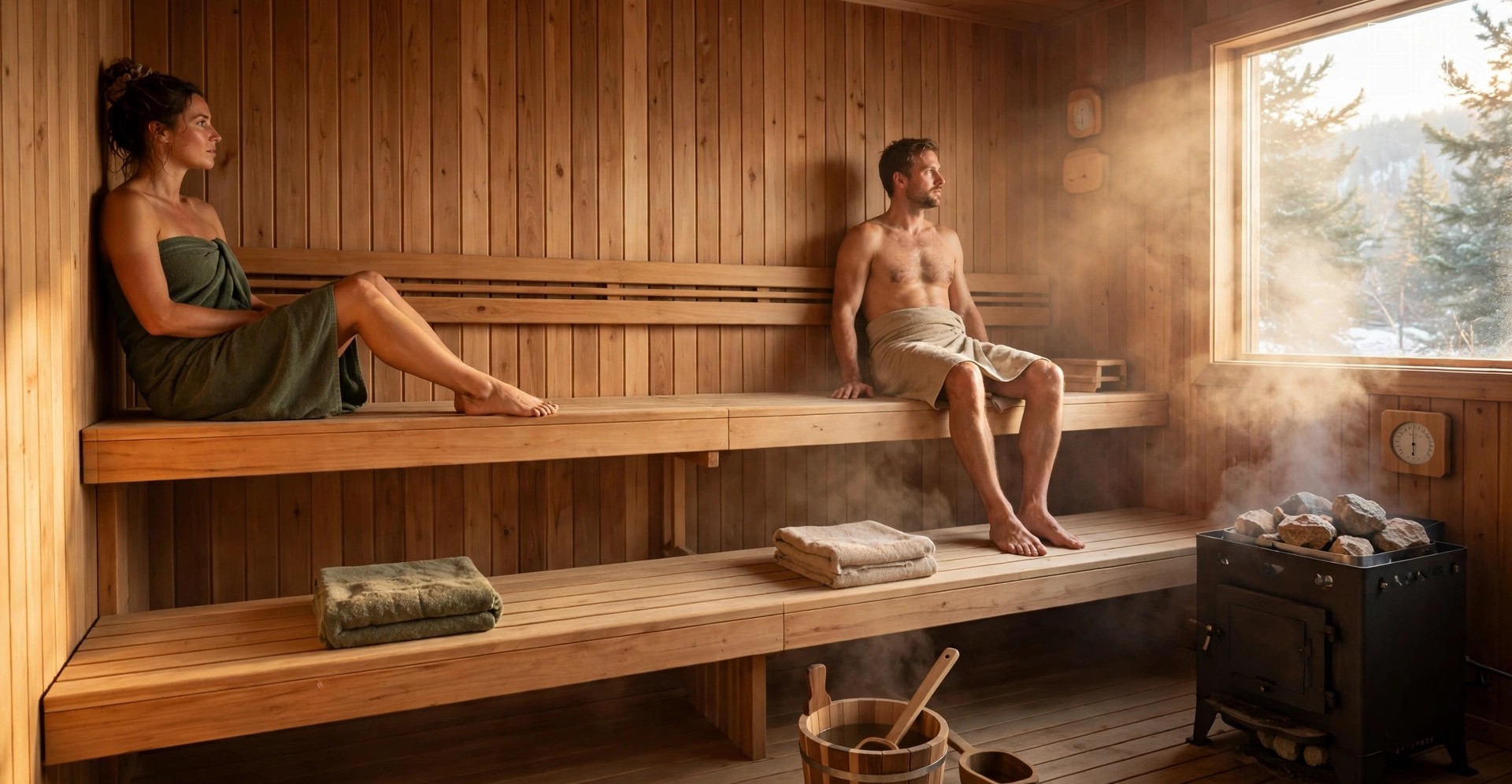
Sauna listings sort cabins by headcount, but the number on the box is a rough guide, not a measurement. A two-person cabin seating two adults shoulder to shoulder differs from one giving them room to stretch out, and a four-person cabin can be a genuinely social room or a two-person cabin with a longer bench. The useful question is not how many people the manufacturer claims, but how much bench, air volume, and heater you are buying.
Key takeaways - Bench length decides comfort more than the headcount label: allow roughly 24 inches per seated adult, more to lie down. - A four-person cabin holds roughly twice the air, so it needs a larger heater and more time or power to reach temperature. - Two-person cabins suit solo sessions, couples, and tight rooms; four-person cabins suit households that sauna together and hosts. - Heater size, not cabin size alone, sets heat-up time: compare kilowatt ratings and voltage first. - Measure the delivery path, not just the room: doorways, turns, and ceiling height decide whether a cabin can reach its spot.
What the Headcount Label Actually Means
Manufacturers count heads by bench length, and they count generously. A bench of about 48 inches is sold as two-person seating, which works if both sitters are comfortable sitting close; a bench of about 72 inches is sold as four-person seating. Neither figure accounts for body size, for lying flat, or for the space a bucket or backrest takes up.
Bench layout matters as much as bench length. Many two-person cabins use an L-shaped bench, suiting one person lying down or two sitting upright; four-person cabins usually add a return bench or a second tier, letting one person recline while others sit. If lying down matters, check the longest unbroken bench run, not the total summed across sides. Ceiling height matters too: traditional cabins are often 72 to 84 inches tall, and a low ceiling can force a shorter cabin.
The Size Comparison
The table below sets the two sizes side by side on typical ranges. Confirm exact dimensions on the model page before ordering.
| Feature | Typical 2-person cabin | Typical 4-person cabin |
|---|---|---|
| Footprint | About 4 by 4 feet | About 5 by 6 feet, up to 6 by 6 feet |
| Longest bench run | About 42 to 48 inches | About 60 to 72 inches |
| Seating layout | One bench, sometimes L-shaped | Straight bench plus return, or two tiers |
| Air volume to heat | Roughly 100 to 150 cubic feet | Roughly 200 to 300 cubic feet |
| Infrared heater power | About 1,750 to 2,200 watts | About 2,800 to 3,600 watts |
| Traditional electric heater | About 4.5 to 6 kilowatts | About 8 to 9 kilowatts |
| Electrical supply | Often 120 volt, 15 or 20 amp | Often 240 volt, dedicated circuit |
| Heat-up time, traditional | About 30 to 45 minutes | About 45 to 75 minutes |
| Best for | Solo use, couples, tight rooms | Families, couples who host, social sessions |
The air-volume row explains most of the rest of the table. Heating twice the air takes more power or more time, and in a traditional cabin usually both. That is why a four-person traditional cabin almost always needs a 240-volt dedicated circuit, while many two-person infrared cabins run on a standard outlet. A new dedicated circuit can add several hundred dollars. One traditional two-person cabin is Renu Therapy's Rusticus 2-Person Indoor Sauna (affiliate link), listed from $5,739.
Outdoor cabins complicate the picture: a four-person outdoor cabin loses more heat in cold weather, so its heater works harder and heat-up stretches. In a cold climate, lean toward the larger heater.
Heat, Heater Size, and Session Feel
In a traditional sauna, the heater warms the air and the stones. A heater too small for the volume reaches temperature slowly and struggles to recover after the door opens or water goes on the stones; one too large cycles on and off, making temperature feel uneven. The kilowatt rating is a sizing tool, not a quality score: match it to the cabin's volume and insulation.
In an infrared cabin, panels radiate heat directly toward the body, so air temperature reads lower and sessions feel warm sooner. Panel placement decides coverage: a two-person cabin with panels on the back, sides, and under the bench warms more evenly than a four-person cabin with panels only on the back wall. Count heated surfaces and positions, not just total wattage; our infrared sauna buyers guide covers panel layouts and heater types.
Session feel depends on how full the cabin is. A two-person cabin used solo feels spacious; with two adults and a bucket it feels snug. A four-person cabin used by two feels generous, though extra air means slower recovery after the door opens. The mistake is buying small for four regular users, or large for a solo user heating twice the air.
Which Size Fits Which Household
The table below matches common household patterns to the size that usually serves them best. Use it as a shortlist filter, then confirm bench and heater figures.
| Household pattern | Size that usually fits | Why, and the trade-off |
|---|---|---|
| Solo user, daily or near-daily sessions | 2-person | Fastest heat-up, lowest running cost; guests sit close |
| Couple who sauna together | 2-person, or 4-person if space allows | 2-person is efficient; 4-person adds lying-down room |
| Couple who regularly host friends | 4-person | Social seating without crowding; higher install and running cost |
| Family with teenagers or adult children | 4-person | Four genuine seats need the longer bench; check bench run, not the label |
| Small room, apartment, or converted corner | 2-person | Fits standard rooms and circuits; measure door swing and delivery path |
| Outdoor cabin in a cold climate | 4-person with the larger heater option | Extra volume plus winter losses; budget for the dedicated circuit |
A cabin is a ten-year purchase. If guests or a partner will join regularly within a few years, the four-person cabin's extra cost is often cheaper than replacing a two-person cabin later; if the household is stable and the room is tight, the two-person cabin is better value.
Room, Delivery, and Installation
Floor space is only the first measurement. A cabin needs clearance for its door to swing and ventilation air around it, especially indoors; our sauna ventilation guide covers intake and exhaust placement and the drying routine that keeps wood healthy. A cabin pushed tight against two walls dries poorly; leave the recommended clearance.
Delivery decides more purchases than buyers expect. Flat-packed cabins arrive as panels, passing through standard doorways more easily than pre-assembled cabins, which need a clear path at full width and height. Measure every doorway, turn, and ceiling on the path, and confirm whether delivery is kerbside or room-of-choice. Installation follows the same logic: many infrared cabins assemble in a day with basic tools, while traditional cabins with a 240-volt heater need an electrician. Our sauna installation guide walks through the sequence; budget the electrical work in.
Price Tiers, Hedged
Prices move with wood species, heater quality, glass area, and brand, so the bands below are broad and hedged on purpose, reflecting typical listed prices across major retailers in 2026. Verify current rates, and compare cabins with similar wood thickness, heater ratings, and warranty.
Two-person infrared cabins are typically listed from around $1,000 to around $3,000; two-person traditional cabins from around $3,000 to $6,000. Four-person infrared cabins run from around $2,500 to $6,000; four-person traditional cabins from around $5,000 to $12,000 or more, with outdoor models and full-glass fronts at the upper end. At four-person traditional size, Renu Therapy's Rusticus 4 Person Indoor Sauna (affiliate link), listed from $6,830, sits inside the band above. Add the dedicated circuit and delivery upgrade to the four-person total.
The running-cost gap is smaller than the purchase gap but real: a larger heater draws more power per session and a larger cabin takes longer to reach temperature, so a four-person traditional cabin used daily costs more to run than a two-person infrared cabin. If it serves four people several times a week, the per-person cost flips.
A note on heat itself: heat is not for everyone. Anyone who is pregnant, has a heart condition, or is trying heat for the first time should keep early sessions brief and mild, leave at the first sign of light-headedness or nausea, and keep water nearby. Skip the sauna entirely on days you have been drinking. For the evidence behind heat exposure, see our sauna benefits evidence review; the home contrast setup guide covers pairing sauna with cold.
Frequently Asked Questions
Is a 2-person sauna actually comfortable for two adults?
It depends on the bench, not the label. A 48-inch bench seats two adults sitting upright with shoulders close. It does not give two adults room to stretch out side by side, and a bucket or backrest takes bench length the headcount figure ignores. Before ordering, check the longest unbroken bench run.
How much bigger is a 4-person sauna in practice?
A four-person cabin typically occupies about one and a half to two times the floor area of a two-person cabin, roughly 5 by 6 feet or 6 by 6 feet against 4 by 4 feet, and holds roughly twice the air volume. That extra volume explains the larger heater, longer heat-up, and frequent need for a 240-volt dedicated circuit. Measure the room, the delivery path, and the ceiling height, and leave the manufacturer's recommended clearance around the cabin.
Do 4-person saunas cost much more to run?
They cost more per session, but the gap depends on heater type and frequency. A four-person traditional cabin with an 8 or 9 kilowatt heater draws substantially more power than a two-person infrared cabin at around 2 kilowatts, and takes longer to reach temperature, so daily solo use in the larger cabin wastes energy. Shared use changes the arithmetic: four people splitting one larger cabin's session cost pay less per person.
Can a 2-person sauna run on a standard household outlet?
Many two-person infrared cabins can, since their heaters typically draw around 1,750 to 2,200 watts on a 120-volt circuit. Traditional two-person cabins usually need more: a 4.5 to 6 kilowatt heater generally requires a 240-volt dedicated circuit installed by a qualified electrician. Four-person cabins of either type usually need a dedicated circuit as well, so confirm the requirements on the specification sheet before ordering.
What should I measure before choosing between the two sizes?
Measure five things in this order: the room's floor area and ceiling height, the door swing and clearance around the cabin's planned position, every doorway and turn on the delivery path, the distance to the electrical panel and whether a dedicated circuit is feasible, and the longest bench run you actually need for how you sit. Marking the footprint on the floor with painter's tape reveals crowding a floor plan hides.
Is it better to buy bigger than I need today?
It depends on how certain the extra use is. Buying a four-person cabin for a household that will plausibly grow or host regularly is often cheaper than replacing a two-person cabin. The price step is modest in some lines: the four-person Rusticus is listed from $6,830 against $5,739 for the two-person version, about $1,100 more. See the Rusticus 4 Person Indoor Sauna (affiliate link) if the household is likely to grow into it. Buying bigger for vague future guests, while heating twice the air for daily solo sessions, is the costlier mistake.
This article is for informational purposes only and does not provide medical advice or guaranteed outcomes.